Strategic Supplier Development Program
From supplier self-declarations to evidence your auditor accepts
Built for procurement and sustainability teams at listed companies sourcing from Asia: engage, assess and develop your strategic suppliers with adaptive questionnaires, multi-stakeholder validation, and AI-powered inconsistency detection.
Questionnaire Engine
Adaptive questionnaires tailored to every supplier
Our engine generates role-specific questions adapted by industry, geography, and supplier maturity level. Questions evolve based on prior answers to maximize data quality in minimal time.
- 10 stakeholder roles per supplier assessment
- Industry-adaptive question logic
- Completion in under 15 minutes per role
- Automatic follow-up on flagged responses
Pricing
Clear pricing per supplier
Two service levels. The standard Strategic Supplier Development Program can be enriched with a physical on-site assessment delivered in partnership with Bureau Veritas, our internationally recognised third-party verification partner.
Automated Tracking
Automated supplier progress monitoring
Track each supplier's development status in real time. Get alerts when performance gaps emerge or certifications expire.
Certificate Tracking
Monitor ISO 14001, SA8000, and custom certifications with automated expiry alerts.
Inconsistency Detection
AI flags contradictions between stakeholder responses, reducing false claims by 85%.
Maturity Scoring
Dynamic supplier maturity scores updated with every new data point, enabling risk-based procurement decisions.
Example program insight
Inconsistency Detected — Supplier #4721
Automotive Tier 1 · Germany
⚠ Cross-Validation Alert
Operations reported 95% waste recycling rate, but Finance disclosed waste disposal costs 3× the industry average. EHS team confirmed no recycling infrastructure on-site. Verified Truth Score dropped from 82 to 54.
This insight was generated automatically by cross-referencing responses from 3 stakeholder roles. Traditional audits would have missed this inconsistency.
A multinational with strong group-level policies can still hide Category 3.11 and social risks at a single site. SSDP cross-checks every layer.
Large-company case: from board intent to shop-floor reality
⚠ Cross-level inconsistency detected
CEO declares free PPE at all sites and a zero-accident objective; workers at Site X report pressure to work without PPE and undeclared accidents.
CEO
- Group safety policy
- Zero-accident objective
- Free PPE provided at all sites
CHRO
- Accident frequency and severity rates
- Occupational health
- Well-being programme
EHS
- Site-specific risk prevention plan
- Chemical product registry
- Evacuation drills
- OHSAS 18001/ISO 45001 certification
Site Supervisor
[Site X]- PPE available and in good condition on this site
- PPE gate check performed
- Accident register maintained
- Fire extinguishers accessible
- Danger zones marked
- Evacuation drills carried out
Worker 1 + Worker 2
[Site X]- PPE provided free of charge
- Pressure to work without PPE
- Accidents not declared on this site
- Physical conditions (heat, noise, dust)
- Access to drinking water
This cross-level check runs automatically in the SSDP workflow — it surfaces hidden risks before they reach the client or the auditor.
Program philosophy
We measure alignment between three levels of the supplier organisation
A declaration is only worth what the shop floor confirms. SSDP interviews three levels separately and compares the answers.
Intentions
Profiles 1–2: Leadership
CEO, CFO
Do they have a clear vision, commitment and budget for sustainability?
Actions
Profiles 3–7: Management
COO, Procurement, Quality, HR, Maintenance
Do they translate intentions into concrete practices, resource allocation and procedures?
Ground reality
Profiles 8–10+: Supervisor + Workers
Anonymous responses
What actually happens on the shop floor — independent of management declarations?
The value of the program lies in the gap between these three levels. A gap is not a failure — it is a precise diagnosis that directs improvement actions.
Activation threshold
Engagement calibrated to supplier size
The depth of the assessment adapts to the size and capacity of each supplier, so no one wastes resources.
Micro
< 20 employees
Level 1
Net Zero Pulse + L1 questionnaire (max 100 questions)
~2h
cumulative
SME
20–99 employees
Level 2
Net Zero Pulse + L2 questionnaire
~10h
cumulative
Mid-size & large
100+ employees
Level 3
Net Zero Pulse + L3 questionnaire
~20h+
cumulative
Tier-2 suppliers: Level 1 is sufficient for initial screening. Full Level 3 assessment is reserved for strategic Tier-1 suppliers.
Profile rules
Who answers, and how many
Field profiles are collected per factory or workshop. Management is collected once, at company level.
Management
- Collected once at company level.
- CEO (Profile 1), CFO (Profile 2), COO (Profile 3)
- Procurement Manager (Profile 4), Quality Manager (Profile 5)
- HR Manager (Profile 6), Maintenance Manager (Profile 7)
Supervisor
- One per factory / workshop to be certified.
- The supervisor is the key witness linking management decisions to day-to-day operational reality.
- Multi-site suppliers designate one supervisor per site.
Workers
- Minimum 2 per factory (at least 1 male + 1 female).
- For 100+ workers: 3–5 recommended per site.
- Seniority: 5 years with the company, or 80% of the company's existence for younger organisations.
Sample Output
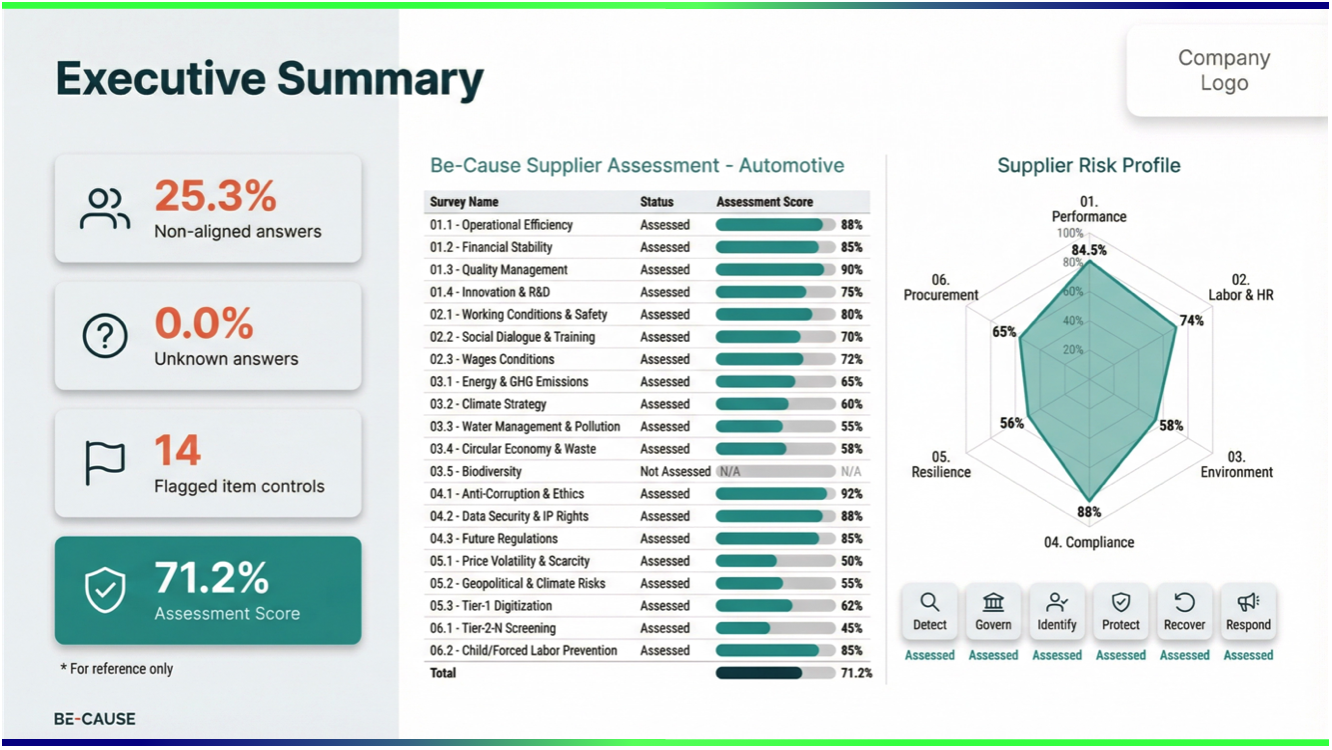
Real supplier assessment output
Executive summary from a BE-CAUSE Strategic Supplier Development Program assessment in the automotive sector — including cross-stakeholder validation scores and risk profiling.
FAQ
Strategic Supplier Development Program — common questions
Start developing the suppliers your CSRD report depends on
Join EU and US listed companies using BE-CAUSE to map suppliers beyond Tier-1, score their readiness, and turn CSRD compliance into a competitive edge.