In food, beverage, retail and catering, the net-zero trajectory is not decided in the factory or the warehouse. It is decided on farms, in product formulation, in what appears on a menu, in the cold chain, and in the ability to shift real consumption. Agriculture concentrates most of the climate exposure of these value chains — and it is the part of the value chain the buyer controls least.
One idea should frame the whole discussion: asking a producer to cut emissions without reducing their economic risk usually just moves the cost off the buyer's balance sheet. It does not remove it, and it does not abate anything. A dairy farmer who is asked to change the ration, cover the slurry store and record data — with no premium, no volume commitment and no technical support — is being asked to fund somebody else's target out of a margin that is already thin.
The levers are not interchangeable
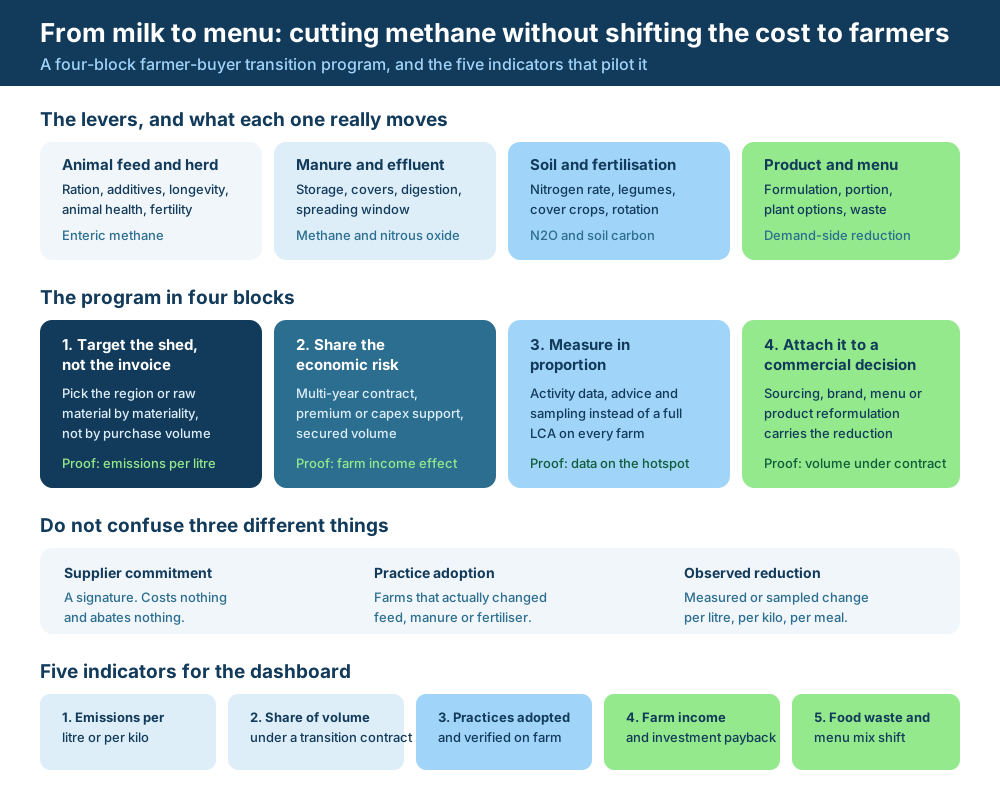
Agricultural Scope 3 is often discussed as one block. It is at least four, and they behave very differently.
Animal feed, herd health and longevity act on enteric methane — the largest single line in dairy and beef. Ration composition, forage quality, feed additives, fertility and the number of unproductive animals all move emissions per litre or per kilo. These levers are fast in accounting terms and slow in practice, because they touch the animal's performance and the farmer's income directly.
Manure and effluent management acts on both methane and nitrous oxide: storage type, covers, anaerobic digestion, and the timing of spreading. This is capital-intensive and highly site-specific; a digester makes sense on one farm and not on its neighbour.
Soil and fertilisation act on nitrous oxide and on soil carbon: nitrogen rate and form, legumes in the rotation, cover crops, tillage. Here the abatement is real but the measurement is the weakest of the four — soil carbon in particular is slow, reversible and hard to attribute to one buyer.
Finally, product formulation, portion design, menu structure and waste act on the demand side. They are the fastest levers available to a food company or a caterer, and the only ones that do not require a farm to change anything.
“Biogenic emissions, soil carbon, modelled reductions and verified reductions are four different objects. A dashboard that adds them together is a communication tool, not a management tool.”
A four-block farmer-buyer program
Block one: define a priority region or raw material from materiality, not purchase volume. The largest supplier by invoice is frequently not the largest by emissions, and the reverse is also true — a modest volume of beef, dairy or palm can outweigh a very large volume of packaging or cereals. Start where a change in practice moves the trajectory.
Block two: offer a contract or a premium that shares the investment and transition risk. Multi-year offtake, a price premium attached to a practice rather than to a certificate, capex support on the digester or the slurry cover, guaranteed volume during the transition years. This is the block that decides whether anything happens at all. Every other block is administration.
Block three: measure in proportion. Combining activity data, technical advice and sampling across a representative group of farms produces a defensible number at a fraction of the cost of a full LCA on every holding. Full farm-level LCAs on a thousand suppliers consume the budget that should have paid for the abatement.
Block four: attach the reduction to a commercial decision — a sourcing volume, a brand, a menu line, a reformulated product. A reduction that is not carried by a commercial decision stays an isolated CSR project and disappears with the next budget cycle.
The tensions nobody should pretend away
Affordability, taste, nutrition, seasonality, availability of alternative proteins, farmer income, data confidentiality and the attribution of a reduction between several buyers on the same farm — these are the real constraints. A program that ignores them fails quietly. The attribution question in particular is unavoidable: three companies buying from the same cooperative cannot each claim the same tonne of avoided methane, and the contract has to say who claims what before the money moves.
Data confidentiality matters as well. Farm-level data is business data. Aggregation rules, retention periods and who sees what should be settled at the start, otherwise the best producers — the ones with something to protect — are the first to stop answering.
Food service: the menu is a decarbonisation lever
For contract catering and retail food service, the fastest reductions are usually not agricultural at all. Menu composition, portion sizing, the quality and placement of plant-based options, and the elimination of preparation and plate waste move the footprint per meal without requiring a single farm to change.
The condition is that it must not become a moral instruction to the diner. Reductions that survive are the ones achieved through better default options, better recipes and better forecasting — not through signage telling people what they should have chosen. Waste is the least controversial and most underexploited lever: it costs money, it emits, and reducing it improves both lines at once.
Five indicators that keep the program honest
- Emissions per litre, per kilo or per meal — the intensity metric, not the absolute total, so growth does not disguise progress or penalise it.
- Share of purchased volume covered by a transition contract — the only indicator that shows whether risk has actually been shared.
- Practices adopted and verified on farm — counted at farm level, with the verification method stated.
- Farm income and investment payback — if this is negative, the program is being funded by the producer and will stop.
- Food waste and menu mix shift — the demand-side line, measured where the buyer has direct control.
The discipline is to never merge three things that a dashboard tends to merge: supplier commitment, practice adoption, and observed reduction. A signature costs nothing and abates nothing. An adopted practice is a real change with an uncertain effect. An observed reduction is measured or sampled. Reporting the first as if it were the third is the most common failure in agricultural Scope 3 programs.
Where the market tools fit — and where they stop
Most food and retail groups already run part of this. EcoVadis and Sedex score management systems and policies. CDP collects disclosure. SBTi FLAG sets the target framework for land-intensive sectors. Carbon accounting platforms — Watershed, Persefoni, Sweep, Normative, Sphera — consolidate the inventory and apply factors, and agri-specific tools model farm emissions. Verification bodies such as SGS, TÜV SÜD and Bureau Veritas assure what can be evidenced. Each does its job. None of them tells a buyer whether this cooperative, this region or this processing site can actually change practice next season, at what cost, and who has to pay for it.
That is the step our two services cover. Net Zero Pulse screens a supplier portfolio site by site and returns, for each one, its evidence level and its capacity to act — so a category manager knows where a transition contract will produce abatement and where it will only produce paperwork. The Strategic Supplier Development Program then works inside the site and its upstream base in the local language: diagnosis, costed projects, buyer–supplier incentives, and verification of what was actually implemented and measured.
| Layer | Typical providers | Question answered | What it does not do |
|---|---|---|---|
| Supplier ratings | EcoVadis, Sedex | Does the supplier have systems and policies? | Says nothing about farm-level capacity to act |
| Disclosure and targets | CDP, SBTi FLAG | Is the commitment disclosed and benchmarked? | Does not fund or implement a practice change |
| Carbon accounting | Watershed, Persefoni, Sweep, Normative, Sphera | What is the consolidated footprint? | Does not produce the producer's primary data |
| Verification | SGS, TÜV SÜD, Bureau Veritas | Does the published figure hold up? | Assures after the fact, does not build the program |
| Screening (Net Zero Pulse) | BE-CAUSE | Which sites can evidence what — and how to steer the whole supplier ecosystem, not one factory at a time | Not a full farm LCA model |
| Program execution (SSDP) | BE-CAUSE | Are the ESG commitments made by sales actually implemented by management and deployed on the shop floor — beyond paperwork and AI-filled questionnaires | Neither a rating nor a reporting platform |
Cost matters here too. A season of questionnaires sent to cooperatives — chasing responses, reconciling formats, re-explaining the functional unit, then repeating it next year on the same volumes — usually consumes more internal time than the data it produces is worth. Net Zero Pulse and the Strategic Supplier Development Program are priced below the administrative time and energy buyers already spend on the same suppliers, they move faster than a questionnaire cycle, and they transfer across industries: the materiality filter, the risk-sharing contract and the proportionate measurement design work the same way whether the upstream is a dairy cooperative, a textile dye house, a chemical plant, an electronics assembler or an automotive stamping shop. That is the moat — cheaper than the status quo, faster than a questionnaire round, and portable from one sector to the next.
The question to put to your agricultural sourcing team
Not "have our farmers committed?" but: for the three raw materials that carry most of our agricultural footprint, what share of volume is under a contract that shares the transition risk, what practices have been verified on the ground, and what did the producer's income do? If the answer is that commitments exist and income fell, the program is not a decarbonisation program — it is a cost transfer, and it will reverse.
Frequently asked questions
References
- SBTi — Forest, Land and Agriculture (FLAG) guidance
- GHG Protocol — Land Sector and Removals Guidance
- FAO — Global Livestock Environmental Assessment Model (GLEAM)
- IPCC — 2019 Refinement to the 2006 Guidelines for National Greenhouse Gas Inventories
- Global Methane Pledge
- IEA — Methane Tracker
- UNEP — Food Waste Index Report
- FAO — Livestock and climate: methane from enteric fermentation
- European Commission — Carbon farming and certification framework
- WRI — Creating a Sustainable Food Future