
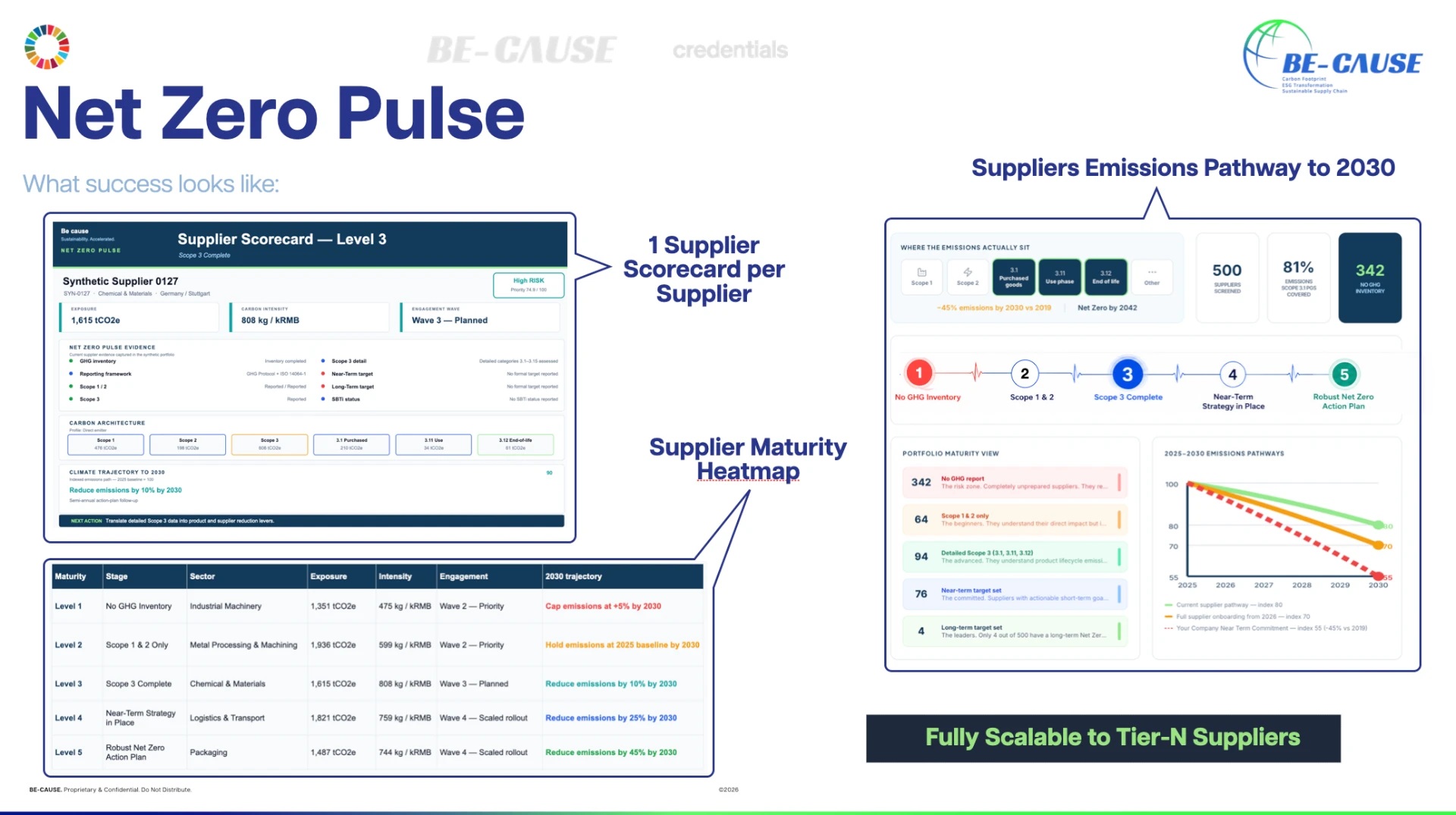
On 19 September 2026, Net Zero Pulse went live. It is the platform we built after years of the same conversation with procurement and sustainability leaders: they know their Scope 3 is mostly upstream, they know their suppliers hold the levers, and they are drowning in questionnaires that produce scores but not reductions. Net Zero Pulse exists to answer a different question — not how each supplier answered, but which suppliers, in which order, with which actions, will actually move your trajectory.
The observation: 2,500 suppliers, zero actionable visibility
A mid-size industrial buyer typically works with several thousand direct suppliers. The standard toolkit sends all of them a questionnaire, waits months, and returns a rating per supplier. What it does not return is a decision: where to spend the next euro of engagement budget, which twenty suppliers account for the majority of the footprint, which ones are ready to act and which ones need capability building first. The result is a reporting exercise that consumes the team instead of a program that changes the supply base.
We kept hearing the same sentence in different forms: « I have a score for every supplier and no idea what to do on Monday morning. » That is the gap Net Zero Pulse was designed to close.
What Net Zero Pulse actually does
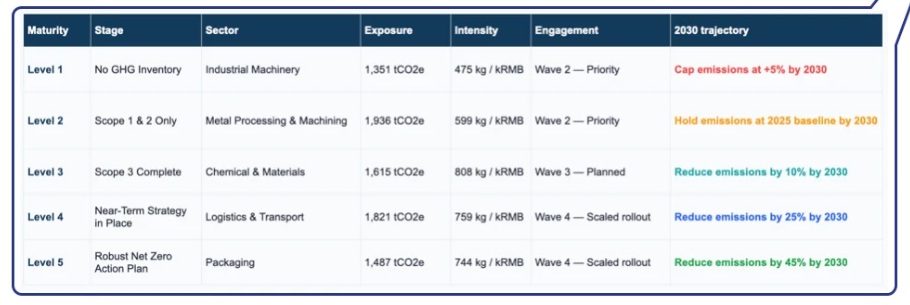
- Ranks the entire supplier ecosystem on real transition levers — energy mix, process emissions, product design, logistics — not on questionnaire completeness.
- Prioritises engagement: which suppliers to approach first, with what ask, based on their weight in your footprint and their readiness to act.
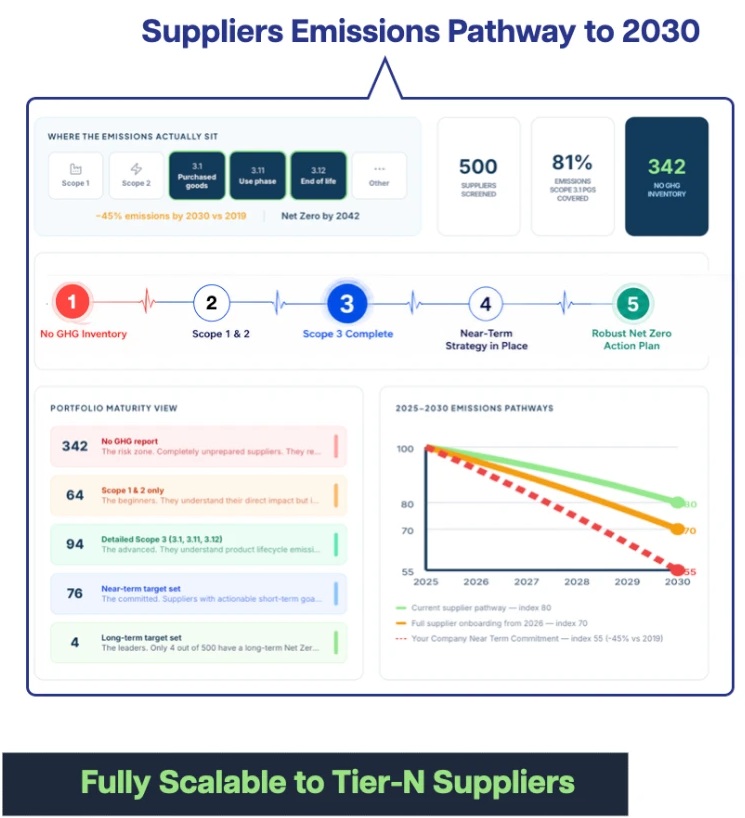
- Builds a reduction trajectory per supplier, so progress is tracked against a path, not against last year's answer sheet.
- Feeds directly into the Strategic Suppliers Development Program (SSDP): once a priority supplier is identified, our teams deploy ESG coherence on the shop floor — beyond paper forms and AI-generated answers.
In short: Net Zero Pulse steers the supplier ecosystem at portfolio level; SSDP executes with the suppliers who matter. One without the other is either a dashboard nobody acts on, or field work without a map.
Why 19 September
The date was not chosen at random. The 2026 disclosure season has just closed, and the 2027 cycle starts now: CDP questionnaires open in the spring, EcoVadis assessments run on annual subscriptions, and most companies set their supplier engagement calendar between October and December. Launching in mid-September means a buyer can onboard its supplier base this quarter, have a prioritised map before the budget season ends, and enter the 2027 reporting cycle with a program already running — instead of scrambling next spring with another spreadsheet.
There is a second reason. Regulation is moving from reporting to performance: CSRD assurance is tightening, CBAM enters its definitive regime, and buyers are increasingly asked not just what their Scope 3 is, but what it will be. A trajectory requires a baseline and a plan — exactly what a portfolio-level pilot provides.
What Net Zero Pulse is not
It is not another questionnaire. Suppliers are not asked to fill in a longer form; the platform works from the data that already exists — procurement data, public disclosures, energy and process information — and targets engagement where data is missing. It is not an audit program either: audits verify a moment in time, Net Zero Pulse tracks a trajectory. And it is not a replacement for disclosure tools like CDP or EcoVadis — it sits upstream, making sure the numbers you will disclose next year are actually improving.
How it compares to the tools you already know
| Tool | What it does well | Where Net Zero Pulse goes further |
|---|---|---|
| EcoVadis | Standardised supplier ratings, widely recognised by buyers. | Ratings per supplier; Net Zero Pulse prioritises across the whole portfolio and attaches an action plan to each priority supplier. |
| CDP | The reference disclosure framework for climate data. | Annual and declarative; Net Zero Pulse is continuous and oriented toward reduction decisions, not disclosure. |
| Watershed / Persefoni / Sweep | Carbon accounting engines that compute your footprint. | They measure; Net Zero Pulse decides where to act and SSDP executes with suppliers on the ground. |
| SGS / TÜV SÜD | Verification and assurance of reported data. | Assurance confirms the past; Net Zero Pulse builds the future trajectory. |
| BE-CAUSE (Net Zero Pulse + SSDP) | Portfolio-level piloting of the supplier ecosystem plus shop-floor execution — at a cost below the administrative time a questionnaire-only approach already consumes. | — |
How to start
The entry point is deliberately simple: our Check My Value Chain Readiness assessment. Ten minutes, no document upload, no commitment. It positions your value chain on the maturity scale and tells you whether Net Zero Pulse is the right next step — or whether a baseline carbon footprint should come first. From there, onboarding a supplier portfolio takes weeks, not quarters.
“A questionnaire tells you what a supplier declared. A pilot tells you what your ecosystem will deliver. We built Net Zero Pulse to be the pilot.”
What to do on Monday morning
- List your top 50 suppliers by spend and ask yourself: for how many do you have a reduction trajectory, not just a score?
- Check your 2027 reporting calendar: when does your CDP or EcoVadis cycle start, and what supplier data will you need by then?
- Estimate the administrative time your team spent on supplier questionnaires this year — that is the budget line Net Zero Pulse is designed to cost less than.
- Take the Check My Value Chain Readiness assessment and see where your value chain stands.