A supplier in eastern China sends a one-page statement: the plant runs on green electricity, the province is a renewable leader, and the product is therefore low-carbon. Six months later, a customer audit finds a captive coal boiler behind the meter supplying all the process steam, and a renewable certificate bought for a calendar year that does not name the site.
Nothing in that sequence is unusual, and nothing in it is necessarily fraudulent. China is simultaneously the world's largest coal-fired power system, the world's largest builder of renewables, and the dominant supplier in dozens of industrial value chains. That combination is exactly what makes a "green factory" claim hard to read from Europe.
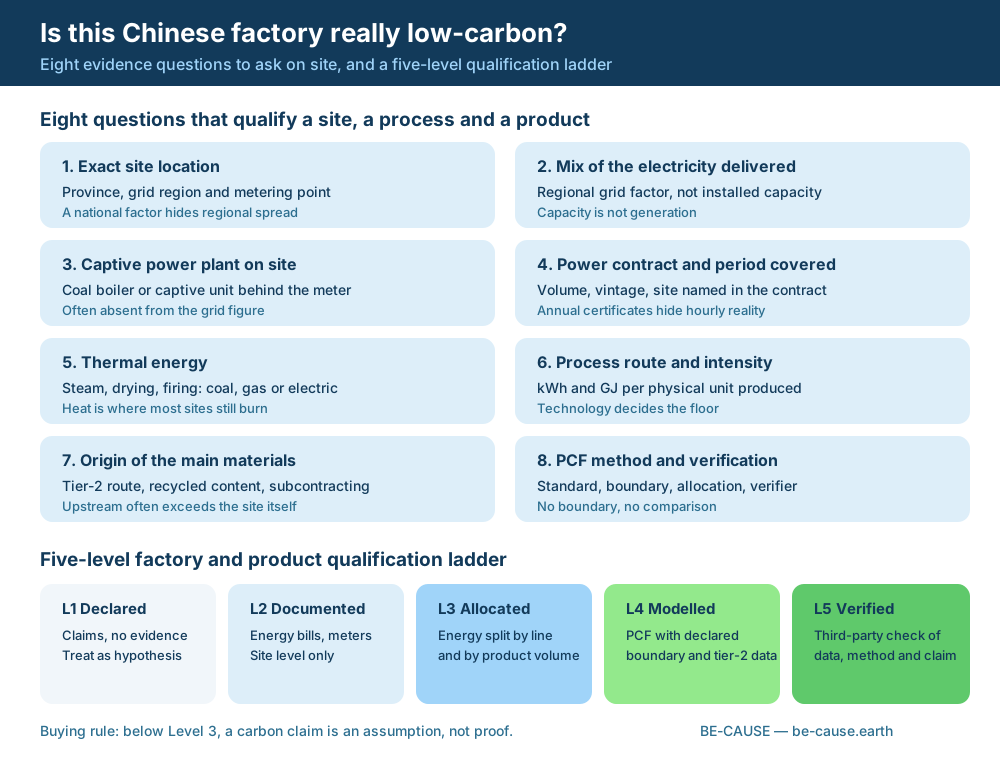
The task is not to judge a country. It is to qualify a site, a process and a product. This article gives the eight questions that do that work, the warning signs that a claim will not survive verification, and a five-level ladder your sourcing, quality and product-carbon teams can apply to any supplier — in China or anywhere else.
Three shortcuts that do not survive contact with a factory
The first shortcut is that a lot of installed renewables means low carbon. Capacity is not generation, and generation is not what a specific meter received at a specific hour. A province can lead national solar installation and still deliver a delivered-power mix dominated by coal during the evening industrial peak.
The second is that a green certificate proves the product footprint. A certificate is a market instrument with a vintage, a volume and a beneficiary. Unless it names the site, covers the period of production and matches the volume actually consumed, it documents a purchase, not a physical supply.
The third is that the national grid factor is enough. National averages exist to make macro comparisons, not to price a supplier decision. Regional grids in China differ substantially, and the gap between a hydro-rich south-western grid and a coal-heavy northern grid is larger than most of the reduction levers a buyer can pull.
“Capacity, generation, contracted energy and consumed energy are four different numbers. Most "green factory" claims collapse the four into one.”
Eight questions to take into a supplier audit
These are written to be asked in a room, with an energy manager present, and answered with documents rather than adjectives.
- 1. Exact site location. Which legal entity, which address, which grid region, which metering points? Multi-site suppliers routinely report the group's best site.
- 2. Mix of the electricity actually delivered. Which regional grid factor applies, for which year, and from which published source? Installed capacity in the province is not an answer.
- 3. Captive generation. Is there a coal boiler, a captive unit, a cogeneration set or a shared industrial-park utility behind the meter? Captive generation is frequently missing from the grid-based number.
- 4. Power contract and period covered. What volume, what vintage, is the site named, and does the contracted period match the production period of the goods we buy?
- 5. Thermal energy. Steam, drying, curing, firing: what fuel, what boiler efficiency, what share of site energy? Heat is where most factories still burn, and it rarely appears in electricity discussions.
- 6. Process route and intensity. kWh and GJ per physical unit produced, by line. Technology sets the floor: no contract can compensate for an obsolete process route.
- 7. Origin of the main materials. Tier-2 route, recycled content, and any subcontracted step — plating, dyeing, heat treatment, moulding — that leaves the audited site.
- 8. PCF method and verification. Which standard, which system boundary, which allocation rule, which verifier, and what is explicitly excluded?
Four numbers that are not interchangeable
| Number | What it measures | What it can prove | How it is misused |
|---|---|---|---|
| Installed capacity | MW built in a province or a country | Direction of the energy transition | Presented as the carbon intensity of a factory's power |
| Generation | MWh actually produced by a technology | Regional grid mix over a period | Applied to a site that draws from a different grid segment |
| Contracted energy | MWh covered by a PPA or certificates | A commercial commitment and its vintage | Treated as physical supply without site, period or volume matching |
| Consumed energy | MWh and GJ metered on the site | The factory's real energy baseline | Reported annually, then applied to a product without production volume |
Red flags an auditor can spot in an afternoon
- No reference year, or a reference year that changes between two documents.
- Reduction and offsetting presented in the same figure, so that a purchased credit hides a flat physical trend.
- A certificate that names the group, not the site that produced your goods.
- Annual site energy divided by nothing: no production volume, no allocation between lines or products.
- Subcontracted steps omitted — the dye house, the plating shop, the foundry that never appears on the audit route.
- A product footprint with no declared boundary, or with cut-off rules that quietly exclude the material-intensive stage.
Two contrasting mini-cases
Electrolytic aluminium from the South-West
A smelter in a hydro-rich south-western province can show a genuinely low electricity factor — during the wet season. The evidence that changes the conclusion is seasonal: monthly metered consumption against monthly grid factors, the contractual position during the dry season when hydro output falls and coal fills the gap, and whether the buyer's production run happened in the right months. An annual average here is not a rounding issue; it can move the product footprint by a factor of two or more.
An electro-intensive material from the North-West
A plant in a north-western province surrounded by wind and solar farms may still be connected to a coal-heavy grid segment, or run a captive unit for stability. Here the decisive evidence is the delivered mix at the meter, the existence and size of captive generation, and whether the renewable contract covers the hours of production rather than a calendar total. Neither case is clean or dirty by geography. In both, the conclusion is set by the evidence, not by the province.
Where the market tools fit — and where they stop
Most buyers already run part of this stack. EcoVadis and Sedex score management systems and policies. CDP collects disclosure and supply-chain questionnaires. Carbon accounting platforms such as Watershed, Persefoni, Sweep, Normative or Sphera consolidate the inventory and apply the factors. Verification bodies such as SGS, TÜV SÜD or Bureau Veritas certify what can be evidenced. Each is good at what it was built for. None of them walks the boiler house.
That is where our two offers sit. Net Zero Pulse screens a supplier base rapidly and tells you, per site and per category, whether the number behind a claim is primary, secondary or purely declarative, and whether the supplier has the capability to improve. The Strategic Supplier Development Program (SSDP) then takes a priority site and turns it into a costed factory plan — local-language diagnosis, metering, engineering options with payback, buyer-supplier incentives, and evidence a verifier will accept.
| Layer | Typical tools | What it answers | What it still leaves open |
|---|---|---|---|
| Supplier ratings | EcoVadis, Sedex | Does the supplier have systems and policies? | Whether the delivered power and the boiler are what they claim |
| Disclosure | CDP, CDP Supply Chain, SBTi | What the supplier declares, and to whom | Whether the declaration is metered or defaulted |
| Carbon accounting software | Watershed, Persefoni, Sweep, Normative, Sphera | A consolidated, auditable inventory | Site-level verification of the underlying claim |
| Maturity screening | BE-CAUSE Net Zero Pulse | Evidence level and supplier capability, site by site | Execution inside the factory |
| Factory execution | BE-CAUSE SSDP | Costed, financed, evidenced reduction plans on site | Group consolidation, handled by the software layer |
| Independent verification | SGS, TÜV SÜD, Bureau Veritas | Whether a claim is externally provable | Nothing to verify without primary data and a real project |
The economics matter as much as the coverage. One supplier questionnaire cycle — chasing responses, cleaning factors, re-explaining the boundary, re-checking the same plants next year — already costs a buying team more internal hours than it ever produces tonnes. Net Zero Pulse and the Strategic Supplier Development Program are priced below the administrative time and energy the company already spends on those same suppliers, and they accelerate decarbonisation across many industries at once: the screening logic, the factory diagnosis and the evidence format hold whether the plant makes textiles, food, chemicals, electronics, packaging or auto parts. That is the moat — cheaper than the status quo, faster than a questionnaire cycle, and transferable from one sector to the next.
The practical limits, stated honestly
Confidentiality is real. A supplier serving competing customers will not disclose line-level production volumes, and process intensity can be commercially sensitive. The workable answer is aggregated intensity ratios verified by a third party, or a non-disclosure perimeter that lets an independent expert see what the buyer cannot.
Some data simply does not exist. Small sites often have no sub-metering, no monthly energy records and no one whose job includes carbon. Asking for a product footprint from such a site produces fiction. The correct first step is metering, not a questionnaire.
Tier-2 is where the footprint often sits and where the buyer has least contact. A tier-1 supplier can rarely compel its own supplier to disclose, unless the buyer creates a commercial reason. And audit cost is finite: full on-site verification of every supplier is not affordable, which is exactly why screening before auditing is the only economical sequence.
A five-level qualification ladder
| Level | What exists | What it supports | Next step |
|---|---|---|---|
| L1 Declared | Statements, marketing material, a certificate copy | Nothing — treat the claim as a hypothesis | Ask for bills and meter readings |
| L2 Documented | Energy bills, purchased volumes, grid region identified | A site energy baseline | Split energy by line and process |
| L3 Allocated | Energy allocated to lines and production volumes | Comparison between suppliers on the same boundary | Model the product with tier-2 inputs |
| L4 Modelled | A product footprint with declared boundary and allocation | Internal decisions, design and sourcing trade-offs | Independent verification |
| L5 Verified | Third-party verified data, method and claim | External claims, tenders, regulatory files | Maintain, re-verify on change |
Use the ladder as a purchasing rule rather than a scorecard. Below Level 3, a carbon claim cannot be compared between suppliers. Below Level 5, it should not be repeated to a customer or a regulator.
The rule to write into your sourcing policy
Without process, energy, materials and verification, a carbon claim is an assumption, not proof. That single sentence, applied consistently, does more for the credibility of a Scope 3 programme than a further year of questionnaires.
It also changes the conversation with suppliers in a useful way. Instead of asking a factory to declare that it is green, you ask it to show what it measures — and then you help it measure the things that are missing. That is the work our 15-minute value chain readiness check starts, and what the Strategic Supplier Development Program finishes on site.
Frequently asked questions
References
- GHG Protocol — Scope 3 Calculation Guidance
- GHG Protocol — Scope 2 Guidance (market-based and location-based)
- IEA — Electricity 2025 and China country profile
- IEA — Emissions Factors database
- National Bureau of Statistics of China — Energy statistics
- China National Energy Administration — renewable capacity and generation releases
- ISO 14067:2018 — Carbon footprint of products
- ISO 14064-3:2019 — Verification and validation of GHG statements
- EU — Carbon Border Adjustment Mechanism (embedded emissions rules)
- PAS 2050 / GHG Protocol Product Standard — product-level boundaries