
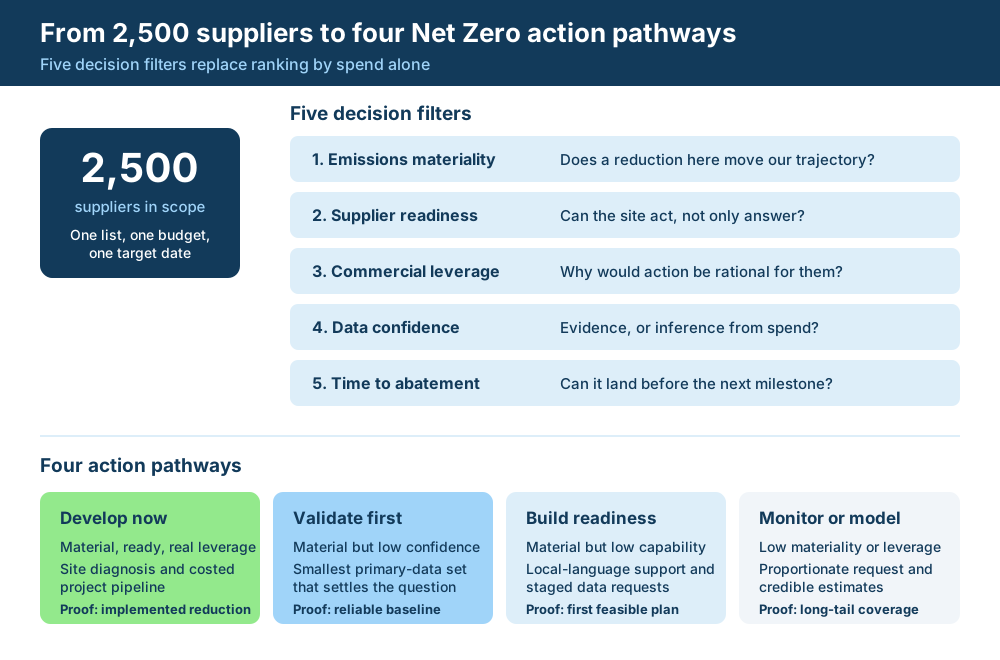
The answer: do not prioritise your supplier base by spend alone. Rank suppliers using five decision factors — emissions materiality, supplier readiness, commercial leverage, data confidence and time to abatement. The result is not a longer questionnaire list. It is an action plan: who to develop now, who to validate, who to engage later and who to model from a distance.
A company with 2,500 suppliers cannot run a deep carbon programme with every one of them. Nor should it. The objective is to direct scarce procurement, sustainability and technical resources towards the suppliers that can change the company's Net Zero trajectory before its next target date.
That distinction matters. A supplier can be large by spend and almost irrelevant to carbon. Another may account for a small share of purchasing cost but sit behind a carbon-intensive material, an energy-hungry process or a coal-heavy manufacturing location. The first is a commercial priority. The second may be the climate priority. Treating them as the same is how a supplier-engagement programme becomes busy without becoming effective.
The GHG Protocol Scope 3 Standard is intended not only to account for value-chain emissions, but also to help organisations identify reduction opportunities and work with suppliers and customers on climate impacts. The Science Based Targets initiative similarly frames supplier engagement as a structured process, not as a one-off data request.
“The practical question is not “Which suppliers should complete our survey?” It is “Which suppliers can credibly reduce the emissions that matter before our deadline?””
Why spend is a poor starting point for Net Zero action
Spend data is useful. It is often the only consistent information available across a long supplier tail, and it can support an initial emissions estimate. But it is not an action strategy.
Two suppliers with the same annual spend can have radically different carbon profiles. One may assemble a low-energy component in a relatively clean grid region. The other may operate a heat-intensive process, buy carbon-intensive material upstream or manufacture where electricity carries a higher emissions factor. A high-spend marketing agency and a lower-spend aluminium casting supplier should not receive the same degree of climate attention simply because their invoices look similar.
The opposite mistake is equally common: a buyer identifies a carbon hotspot, sends every supplier in that category the same questionnaire, then interprets submitted data as progress. Data collection is necessary, but it is not a reduction. A useful prioritisation method separates information gathering from intervention.
| If you rank by… | You will tend to prioritise… | What you may miss |
|---|---|---|
| Annual spend | Commercially large suppliers | Carbon-intensive processes, materials and sites hidden behind lower spend |
| Response rate | Suppliers already comfortable with reporting | Material suppliers that need technical or language support before they can respond |
| Supplier ESG rating alone | Policy maturity and disclosure | Whether a specific site has an actionable, costed reduction path |
| Estimated emissions alone | The largest theoretical hotspots | Suppliers where the buyer has little influence or where action cannot happen in time |
| The five-factor model | Material, actionable and verifiable opportunities | Far fewer blind spots — and a clear reason for every engagement decision |
The five factors that should determine supplier priority
A credible supplier-prioritisation model considers five factors together. No single factor is sufficient. A material supplier with no realistic route to action this year needs a different intervention from a lower-emission supplier that can deliver a verified efficiency project in six months.
1. Emissions materiality: where is the carbon likely to sit?
Begin with the best available estimate of each supplier's contribution to your footprint. Use spend, purchasing category, material or product volumes, process information and location to create an initial view. Then improve the estimate as supplier-specific data becomes available.
The purpose is not to pretend that the first model is perfect. The purpose is to identify which assumptions are important enough to test. In a mature programme, materiality includes both absolute emissions and emissions intensity. A supplier may be significant because it produces a large volume for you, because its process is carbon intensive, or because it supplies a component that dominates the product footprint.
Decision question: if this supplier reduces its operational or product carbon intensity, would the reduction materially affect our Net Zero trajectory?
2. Supplier readiness: can this supplier act, not just answer?
Readiness measures whether a supplier can move from a request to a credible action plan. It is not a test of whether the supplier has perfect ESG documentation. A factory can have limited reporting maturity and still be ready to improve if it has engaged management, basic energy data, a process owner and a willingness to invest.
Useful readiness indicators include governance, available energy or production data, existing targets, energy-management routines, management ownership and the supplier's ability to identify improvement projects. A weak score is not a reason to abandon a material supplier. It is a reason to choose the right intervention: capability building, local-language support, an energy diagnosis or a staged data request.
Decision question: what is the next practical step that this supplier can complete within the next reporting cycle?
3. Commercial leverage: does the buyer have a reason to be heard?
Suppliers do not invest in decarbonisation because a buyer sends an aspirational letter. They invest when carbon performance connects to a commercial relationship: volume, contract duration, product specification, preferred-supplier status, payment terms, co-investment or access to technical support.
Commercial leverage is not only about the buyer's proportion of supplier revenue. It also reflects the strategic importance of the relationship, the availability of alternatives, contract renewal timing and the buyer's ability to work with the supplier on a product or process change. This is the point where procurement and sustainability must decide together.
Decision question: what commercial or technical mechanism could make action rational for this supplier?
4. Data confidence: how much of the score is evidence, and how much is inference?
Not all supplier data deserves the same level of trust. An estimate based on spend and an industry-average factor should not be treated as equivalent to site-level energy data backed by utility invoices, production records or independent verification.
Assign a confidence level to every material score. A low-confidence, high-emissions supplier is often not an immediate reduction project; it is an immediate validation priority. This prevents a common failure: committing resources to an apparent hotspot that disappears as soon as better data arrives, while ignoring a real hotspot that a weak model failed to reveal.
Decision question: what evidence would most change our decision about this supplier?
5. Time to abatement: can a reduction happen before the target date?
A Net Zero strategy is governed by deadlines. A supplier may have substantial emissions but face a five-year equipment cycle, limited grid options or an unresolved product-design constraint. Another may be able to reduce energy use quickly through process optimisation, maintenance, heat recovery, material substitution or an existing renewable-energy option.
Time to abatement combines technical feasibility, project maturity, capital availability, operational disruption, permitting or grid conditions, and the supplier's own decision speed. It does not favour only quick wins. It makes the time requirement visible, so the buyer can run a portfolio of immediate projects, medium-term capital projects and longer-term product or sourcing changes.
Decision question: what can this supplier deliver before our next milestone, and what must begin now for a later reduction to count?
Turn five factors into four actions
The value of a scoring model is not the score. It is the action that follows. Once the five factors are visible, every priority supplier should fall into one of four practical pathways.
| Supplier pathway | Typical pattern | What the buyer should do | What success looks like |
|---|---|---|---|
| Develop now | High materiality, sufficient readiness, real leverage and a near-term reduction path | Start a supplier-development programme, site diagnosis or targeted project pipeline | A costed action plan, accountable owner, implementation milestones and evidence of results |
| Validate first | High materiality but low data confidence | Request the smallest set of primary data that can confirm or disprove the hotspot | A more reliable carbon baseline and an informed decision to develop, monitor or deprioritise |
| Build readiness | Material supplier with low capability or weak engagement | Provide local-language guidance, management engagement, training and a staged request; connect action to commercial incentives | A named owner, usable energy and production data, and a first feasible improvement plan |
| Monitor or model | Low materiality, low leverage or no viable near-term route to change | Keep a proportionate data request and use credible estimates; do not consume scarce technical resources | Appropriate long-tail coverage without treating every supplier as an identical intervention |
This approach does not remove judgement. It makes judgement consistent. It gives a CPO, CSO and category manager a common language for explaining why one supplier receives a factory visit while another receives a lighter data request.
A six-step method for prioritising a 2,500-supplier base
Step 1: Define the decision you need to make
Do not begin with a questionnaire. Define the specific decision the programme must support: selecting 100 suppliers for focused engagement, deciding where to invest technical support, identifying which categories require Tier-N mapping, or creating a credible supplier-engagement target.
Set a timeframe. “Reduce supply-chain emissions” is too broad to guide a supplier programme. “Identify the suppliers that can affect our 2030 interim target, with a first action cohort this year” is operational.
Step 2: Build a first-pass supplier carbon map
Reconcile the supplier master, purchasing categories, spend and available volume or bill-of-material information. Apply the best available sector, material and location assumptions. Keep the assumptions visible rather than hiding them inside a dashboard. The output is a preliminary map, not a verified inventory. Its purpose is to reveal where a better decision requires better data.
Step 3: Screen climate maturity and engagement readiness
Ask targeted questions that determine action readiness: who owns energy and carbon decisions, what primary data exists, which processes dominate energy use, whether an improvement plan or target exists, and what support the supplier needs.
For suppliers in China and Asia, this step must respect the operating reality of the factory. Use clear local-language communication, request only the data that serves a defined decision, and distinguish data that can stay locally controlled from the scores or evidence a buyer needs to act. A remote English-language questionnaire is rarely a supplier-development programme.
Step 4: Add commercial leverage and project timing
Bring procurement into the scoring process. For every material supplier, identify the relevant commercial moment: a sourcing event, a contract renewal, a new product introduction, a volume commitment or a supplier business review.
Then assess time to abatement. Which projects are feasible now? Which require engineering, finance or a product-design decision? Which must start immediately to influence the next target period? This is how a carbon map becomes a procurement action plan.
Step 5: Hold a cross-functional prioritisation workshop
The most useful output is a short, defensible priority list — not a ranking of every supplier down to the decimal point. Procurement, sustainability, finance, operations and, where relevant, quality or product teams should agree the first cohort and the type of intervention each supplier needs.
| Question | Required outcome |
|---|---|
| Why does this supplier matter? | A materiality statement and confidence level |
| What is the next action? | Validation, readiness support, site diagnosis, project development or monitoring |
| Who owns the relationship? | A buyer-side commercial owner and a supplier-side accountable person |
| What proves progress? | A defined evidence pack: data, action-plan milestone, implementation record or reduction evidence |
Step 6: Refresh the priority list as evidence improves
Prioritisation is not an annual ritual. Refresh it when supplier data improves, purchasing patterns change, a project is completed, a contract is renegotiated or a new product shifts the carbon profile. The best programmes become more selective over time: the long tail stays proportionately managed, while the highest-potential suppliers move from estimate to evidence, from evidence to project, and from project to measurable reduction.
What this looks like in a China and Asia supply chain
A European or US buyer may see one supplier record. On the ground, that record can represent multiple legal entities, production sites, subcontractors, energy sources and decision makers. A credible supplier-prioritisation programme needs to recognise that operational complexity.
That means going beyond a national-average view of carbon: understanding the relevant factory, its energy and process context, its ability to share evidence, and the relationship through which the buyer can create momentum. It also means being honest about the limits of a remote score. A maturity screen can tell you where to look. It cannot, by itself, prove a reduction or replace an engineering diagnosis.
For priority sites, the goal is a workable sequence: local engagement, a defined baseline, an economically credible project, implementation support and evidence of the result. This is where supplier development becomes a business-model discussion as well as a carbon discussion. The best projects reduce energy waste, protect competitiveness and build resilience alongside emissions reductions.
What not to do
- Do not ask all 2,500 suppliers for the same information at the same time. You will create fatigue, not focus.
- Do not equate a supplier's disclosure score with its reduction potential. A polished report is not a project pipeline.
- Do not treat every modelled carbon number as equally certain. Prioritisation needs confidence labels so the programme knows when to validate before it intervenes.
“A score is useful only when it changes what you do next.”
How Net Zero Pulse helps
Net Zero Pulse is designed for the decision between “we know we must act” and “we know where to start.” It rapidly screens supplier climate maturity and combines it with the criteria that matter to procurement: materiality, readiness, leverage, data confidence and time to action.
The output is not a generic ESG ranking. It is a prioritised supplier action map that helps your team decide which suppliers to develop now, which claims to validate, which capabilities to build and which long-tail suppliers to manage proportionately.
If your supplier base is too large to engage blindly, start with a Value Chain Readiness Check. Together we can identify the decisions, data and first supplier cohort needed to make your Net Zero programme operational.