Fast read: EUDR preparation starts with the product and its material origins, not a completed supplier questionnaire. Check Annex I codes, distinguish packaging from products, test recycled-content claims and connect origin evidence to each relevant flow. A supplier name is a contact point; it is not proof of where a commodity was produced.
Published 28 October 2026, this article is one of an eight-Wednesday series. It focuses on EUDR material traceability rather than repeating the wider regulatory overview.
1. Start with the Annex I product code
EUDR Regulation (EU) 2023/1115 covers specified commodities and relevant products listed in Annex I. A commercial description such as “sustainable packaging” cannot settle scope. Record the product code, composition, transaction and intended use, then compare these with the current Annex I wording. Do not automatically classify cotton or wool as EUDR-covered merely because they are textile inputs.
2. Separate paper products from supporting packaging
Hypothetical example: a business sells empty paperboard cartons and also ships electronic components inside cartons. Paper or board placed on the market as products may fall within listed codes; packaging used exclusively to support, protect or carry another product is treated differently. Record both flows separately. A common supplier and identical-looking material do not make their scope analysis interchangeable.
3. Test recycled and leather assumptions
“Recycled” is not a blanket exemption. The waste-derived exclusion has conditions, including whether a product is produced entirely from material that completed its lifecycle and would otherwise have been discarded as waste. Manufacturing by-products require particular care. For mixed inputs, establish which material remains relevant and retain composition and provenance evidence.
For leather, check the actual Annex I code. A proposed removal of cattle leather must not be treated as adopted law. Keep procurement instructions tied to the current legal text, not a draft announcement.
4. Build an evidence chain, not an attachment folder
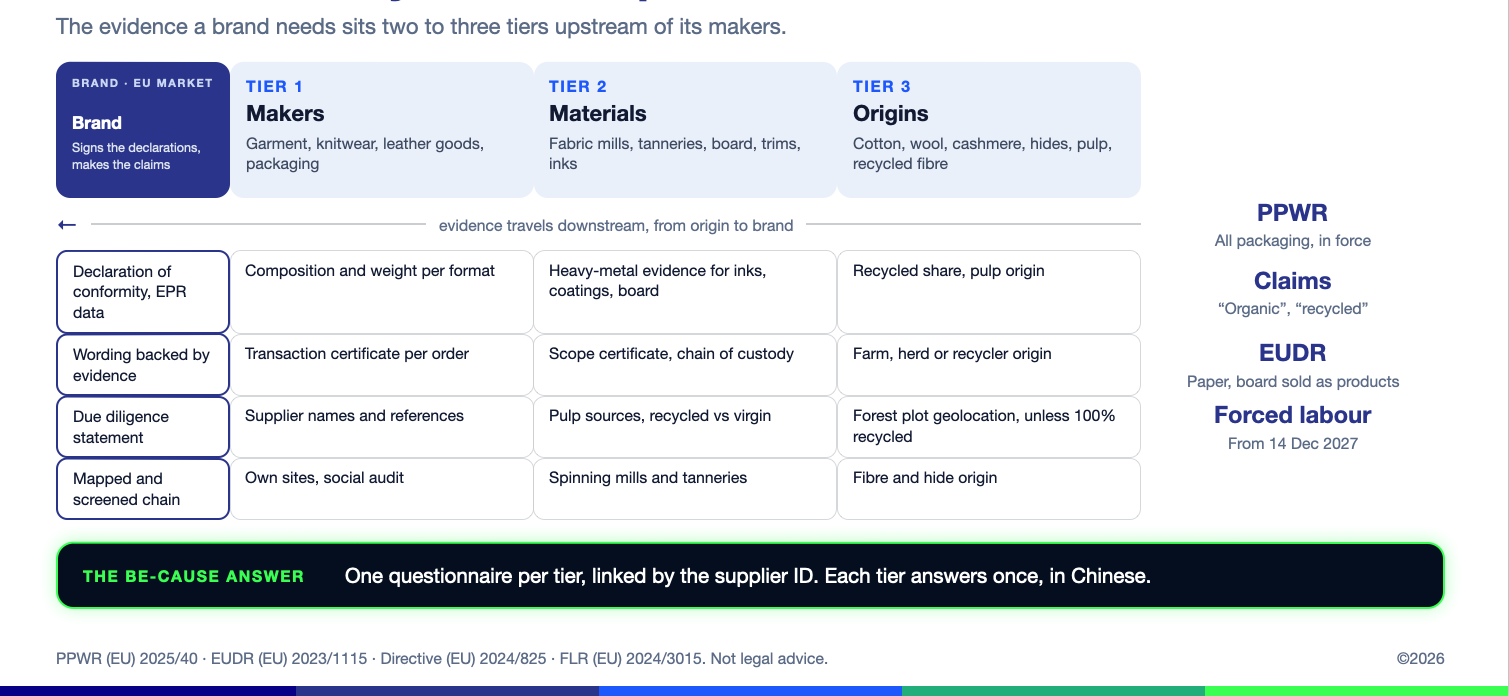
For an in-scope flow, connect product, shipment or lot, quantity, commodity and source records. Obtain the required production-plot geolocation and production date or time range, with applicable commodity-specific information. Connect these to evidence of deforestation-free production and compliance with relevant production-country legislation. A certificate can contribute evidence; it does not replace the required due diligence.
Hypothetically, a trader provides a mill address but no upstream plot data. Flag the gap rather than treating the address as origin proof. Assign an owner, assess risk and determine necessary mitigation and due diligence statement handling before the relevant market action.
5. Give complementary tools distinct jobs
| Layer | Tools or approach | Contribution |
|---|---|---|
| Assessments | EcoVadis / Sedex | Sustainability assessments and supplier information; supporting context. |
| Disclosure and targets | CDP / SBTi | Environmental disclosure and science-based target setting, respectively. |
| Accounting | Watershed / Persefoni / Sweep / Normative / Sphera | Carbon accounting and sustainability data management, depending on offering. |
| Verification | SGS / TÜV SÜD | Verification and assurance services within agreed scopes. |
| Supplier ecosystem | BE-CAUSE Net Zero Pulse | Portfolio steering, supplier maturity and data confidence; already delivers ESG disclosure and Scope 3 value. |
| Execution | SSDP | Management commitments coherently deployed on the shop floor, beyond paperwork or AI forms, with costed execution and evidence. |
BE-CAUSE’s positioning is priced below the buyer’s administrative time and energy for repetitive supplier work, faster than a questionnaire cycle, and transferable across textiles, food, chemicals, electronics, packaging and automotive. This is positioning, not a claim of validated, measured ROI.
6. Turn gaps into costed supplier actions
- Confirm codes, material composition, role and transaction for each priority flow.
- Map upstream sources and list missing geolocation, production-time and legality evidence.
- Assign each gap a supplier owner, buyer reviewer and deadline.
- Cost the work: tracing, translation, system changes, training and any required checks.
- Translate management commitments into receiving controls, lot identification and documented escalation.
- Review evidence quality and unresolved risk before closing an action; retain version history.
7. Qualify the rules, then prioritize
Regulatory qualification: check current consolidated application dates, Annex I, product code, operator role and jurisdiction. Obligations depend on the applicable provisions and circumstances; this article is not legal advice. Connected evidence supports preparation, not certified compliance. For parallel emissions work, apply the GHG Protocol Scope 3 method; carbon accounting does not settle EUDR scope.
Next, prioritize a manageable supplier group by potentially covered material flows, sourcing risk, evidence gaps and purchasing significance. Resolve one representative flow end to end before expanding the request across the supplier base.