

By Emmanuel Delplanque, Co-Founder & CEO, BE-CAUSE
If your brand sells physical products into the European Union market, the era of voluntary sustainability reporting is officially over. Driven by the Ecodesign for Sustainable Products Regulation (ESPR), the EU is rolling out the Digital Product Passport (DPP). This is not just a regulatory update — it is a structural transformation in global manufacturing and trade. As of 2026, the foundational infrastructure goes live and the clock is ticking for major industries to comply.
This deep dive explains exactly what the DPP is, how it works, which industries it impacts in 2026 and beyond, and the implications for global supply chains — including the critical role of Chinese manufacturing.
Executive summary
- The DPP is a mandatory machine-readable record linked to every product via QR code, NFC or RFID, structured on open standards such as ISO/IEC 15459.
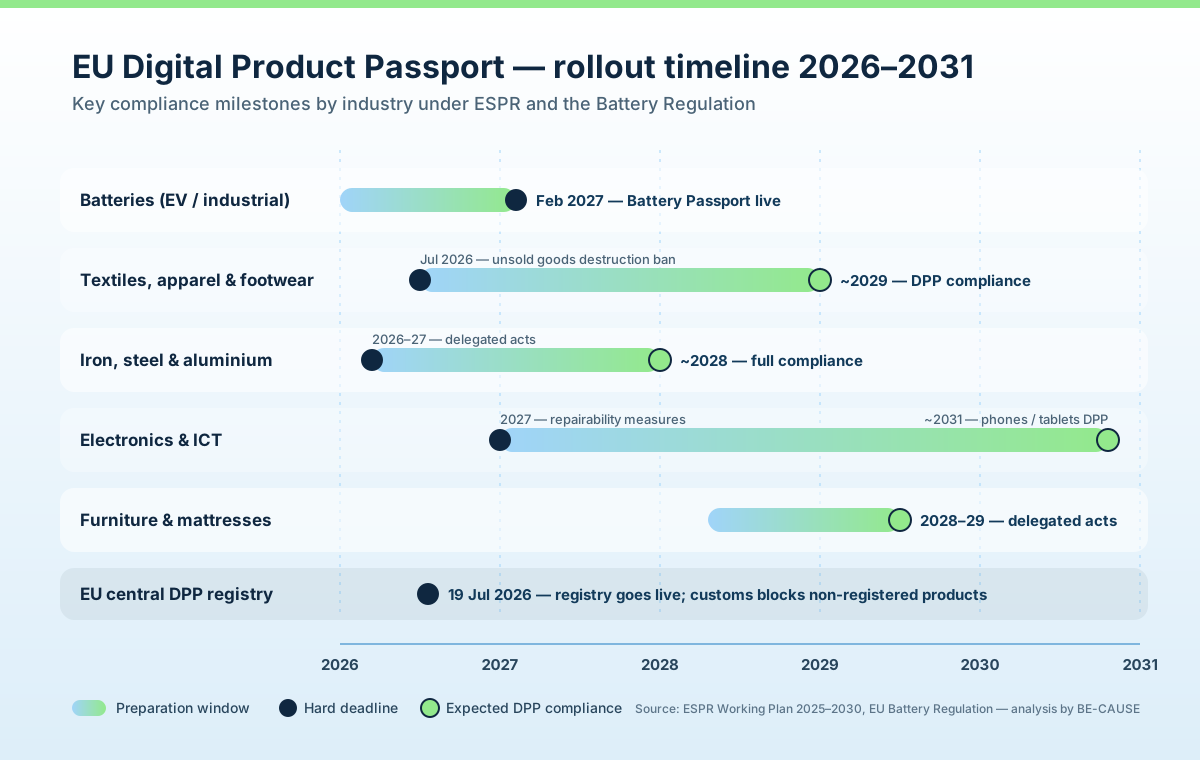
- By 19 July 2026 the EU Central DPP Registry goes live; customs authorities will block non-registered products at the border.
- Also on 19 July 2026, the destruction of unsold clothing, accessories and footwear is banned for large enterprises.
- Battery Passport becomes mandatory on 18 February 2027 — 2026 is the critical preparation year.
- Iron and steel will be the first intermediate products covered by a delegated act; textiles, electronics, furniture follow on an 18-month transition window.
- DPP is an EU regulation with global reach: Chinese manufacturers are launching their own DPP pilots and pushing for mutual recognition.
1. What is a Digital Product Passport (DPP)?
At its core, a Digital Product Passport is a mandatory, structured digital record linked to a physical product via a unique data carrier — most commonly a QR code, NFC tag or RFID chip. It serves as a secure digital twin, providing verified access to a product's entire lifecycle data, from raw material extraction to end-of-life recycling.
The DPP is the technological enforcement mechanism of the EU's Ecodesign for Sustainable Products Regulation (ESPR), which entered into force in July 2024. The goal is to ensure that almost all physical goods placed on the EU market are durable, repairable, recyclable, and environmentally transparent.
1.1 What data must a DPP contain?
A compliant DPP cannot be a static webpage or a simple PDF. It must use a Unique Product Identifier (UPI) and rely on interoperable, machine-readable data structures based on open standards (notably ISO/IEC 15459). Depending on the product category, a DPP typically includes:
- Bill of Materials (BOM) & sourcing: material composition, component origins, proof of ethical sourcing.
- Environmental & carbon footprint: verified Product Carbon Footprint (PCF) and continuous Lifecycle Assessment (LCA).
- Substances of concern: full transparency on hazardous chemicals to ensure safe recycling and REACH compliance.
- Circularity & repairability indices: maintenance instructions, spare parts, disassembly guidelines, end-of-life routing.
- Regulatory compliance data: proof of conformity, safety certifications, adherence to EU standards.
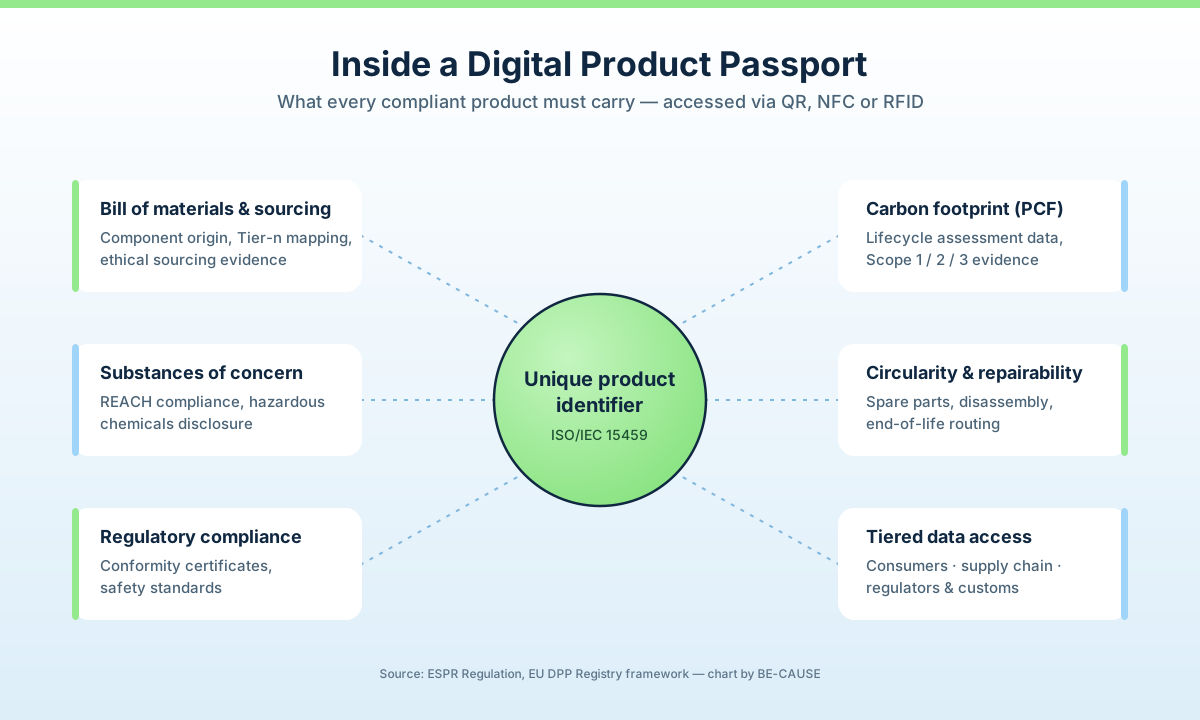
Access to this data is tiered. Consumers might scan a QR code to see sustainability credentials and recycling guidance. Supply chain partners and retailers access compliance certificates and logistics data. Regulators and market surveillance authorities access the full dataset to run automated compliance checks.
2. The 2026 landscape: infrastructure and early movers
While the most famous deadline for the DPP is the February 2027 mandate for batteries, 2026 is the foundational year when the infrastructure goes live and the first hard compliance deadlines hit for specific sectors.
2.1 The EU Central DPP Registry goes live
By 19 July 2026, the European Commission is expected to establish the Digital Product Passport Registry. This registry will store unique identifiers and support DPP registration and lookup. Economic operators must be 'verified' to register passports, and customs authorities will use the registry to verify compliance at the border. Without a registered DPP, products will be blocked from entering the EU market.
2.2 Technical standards finalized
In 2026, the European standardization bodies (CEN/CENELEC) are finalizing the harmonized technical standards for the DPP under mandate M/604. These standards dictate the data structures, APIs and security protocols that every DPP platform must build against.
2.3 The unsold goods destruction ban
On 19 July 2026, a hard ban takes effect for large enterprises prohibiting the destruction of unsold clothing, clothing accessories and footwear. This is the first major ESPR compliance deadline for the fashion industry, forcing brands to improve inventory management and circularity ahead of full DPP implementation.
2.4 Delegated acts for priority industries
Throughout 2026, the European Commission is adopting the first product-specific delegated acts. Iron and steel are slated to be the first intermediate products covered, setting a precedent for data requirements. Delegated acts for textiles and apparel are expected to follow closely, triggering an 18-month countdown to mandatory compliance.
3. Which industries are affected?
The ESPR framework is rolling out industry by industry. The roadmap for the priority sectors is summarized below.
| Industry / product category | Key milestones & deadlines | Core data requirements |
|---|---|---|
| Batteries (EV, industrial, LMT) | 18 Feb 2027: mandatory Battery Passport. 2026 is the critical preparation year. | Chemistry, capacity, carbon footprint, recycled content, supply chain due diligence. |
| Textiles, apparel & footwear | 2026: destruction ban for unsold goods. 2027: delegated act expected. ~2028/2029: full DPP. | Fiber composition, country of origin, carbon footprint, microplastics, recycling pathways. |
| Iron, steel & aluminum | 2026–2027: delegated acts adopted. ~2028: full compliance. | Material composition, environmental performance, recycled content. |
| Electronics & ICT | 2027: repairability measures. ~2031: mobile phones / tablets DPP compliance. | Material composition, repairability index, spare parts availability. |
| Furniture & mattresses | 2028–2029: delegated acts adopted. | Material composition, durability, disassembly instructions. |
The exact timeline is governed by the ESPR Working Plan 2025–2030, with an 18-month transition period following the adoption of each delegated act.
4. The global impact: Chinese manufacturing and interoperability
The DPP is an EU regulation, but its impact is inherently global. Because the obligation lies with the economic operator placing the product on the EU market, manufacturers outside the EU must supply the underlying data.
4.1 The role of Chinese manufacturing
China, as the world's largest manufacturing hub, plays a pivotal role in the success of the DPP. Chinese suppliers must adapt to provide granular, verifiable data on raw materials, carbon emissions and labor practices. Recognizing this shift, China is proactively building its own DPP framework. In 2025, the China Academy of Information and Communications Technology (CAICT) introduced a roadmap for a national DPP system, prioritizing textiles and lithium-ion batteries. China has already launched a battery passport pilot, assigning unique digital IDs to track raw materials and carbon emissions.
Crucially, Chinese experts are advocating for mutual recognition and interoperability between their national system and the EU's DPP registry. This alignment is vital to streamline global trade, reduce compliance costs, and prevent supply chain bottlenecks.
4.2 Regulatory risk and traceability
For buyers, importers and global brands, the DPP introduces severe regulatory risks. A lack of supply chain traceability is no longer just a reputational issue — it is a market access barrier. If a brand cannot verify the origin of its materials, prove chemical compliance, or substantiate its green claims, its products can be denied entry at EU customs, withdrawn from the market or subjected to heavy fines. Common risks include incomplete supplier data, non-EU supplier readiness gaps, and last-minute compliance failures. Companies must urgently map their supply chains, engage with tier-2 and tier-3 suppliers (especially in manufacturing hubs like China), and invest in robust product data management systems.
5. Beyond compliance: the strategic opportunity
While the DPP presents a formidable compliance challenge, industry leaders are treating it as a strategic asset. By digitizing product data at scale, companies can unlock powerful new capabilities:
- Combating greenwashing: with the EU Empowering Consumers Directive (ECGT) taking effect in 2026, generic claims like 'eco-friendly' are banned without substantiation. The DPP provides the verified data needed to back up sustainability marketing.
- Enabling circular business models: DPPs make reuse, refurbishment, resale and recycling more efficient. When a product can instantly identify its material composition, secondary markets and take-back schemes become highly profitable.
- Building consumer trust: modern consumers demand transparency. Brands that provide verified product information via a simple QR code scan build stronger trust and loyalty, turning compliance into a competitive differentiator.
“The Digital Product Passport is rewriting the rules of global commerce. 2026 is the year the infrastructure is built and the first major deadlines hit. Brands that wait until 2027 or 2028 to act will find themselves locked out of the European market.”
6. How BE-CAUSE helps you get DPP-ready
BE-CAUSE's platform combines tier-n supplier mapping, multi-stakeholder data validation, and Scope 3 emissions intelligence — the same primitives every Digital Product Passport ultimately needs. Whether you are preparing for the Battery Passport in February 2027, the textile delegated act, or the steel and aluminum data requirements, we help you collect verifiable data once and reuse it across CSRD, CBAM and the DPP — including from suppliers operating under China's Decrees 834 and 835.
Frequently asked questions
References
- Caruma — What Is a Digital Product Passport? Complete EU Guide (2026)
- Switzerland Global Enterprise — EU's Digital Product Passport: What It Is and How to Prepare
- Circularise — Digital product passports (DPP): what, how, and why?
- inriver — Digital Product Passport (DPP): EU requirements, timeline, and how to prepare
- PassportCraft — DPP Timeline 2026–2030: Every Product, Every Deadline
- DigiProd Pass — The Ultimate Guide to Digital Product Passports
- Euverify — How the EU DPP Will Work in Practice: From QR Codes to Supply Chain Data
- HKTDC Research — Proposed EU Rules Clarify Operation of DPP Registry
- DigiProd Pass — Battery Passport Deadlines Before 2027
- Carbonfact — Digital Product Passport for Textiles
- RAIN Alliance — Why DPP Will Reshape Global Manufacturing
- Renoon — Which Other Countries Are Implementing Digital Product Passports?
- Deloitte — The Sustainable Consumer 2024