
In glass, tyres, ingredients, fermentation, industrial gases and building materials, the blocker is no longer climate ambition. It is the boiler house, the furnace, the steam network, the process temperature and the equipment renewal calendar. Industrial directors have to decide with volatile energy prices, grids that are sometimes constrained, technology that is not mature at every temperature, and assets designed to run for decades.
So the question is not "which clean energy should we choose?". It is: which thermal demand can we eliminate, shift, electrify or replace without putting the process at risk? Answered in that order, industrial heat stops being a technology debate and becomes an investment sequence.
This article gives the five-step decision order, a sorting grid by temperature, volume and remaining asset life, the arbitration criteria that decide a business case, and the three decisions most industrial groups take too early.
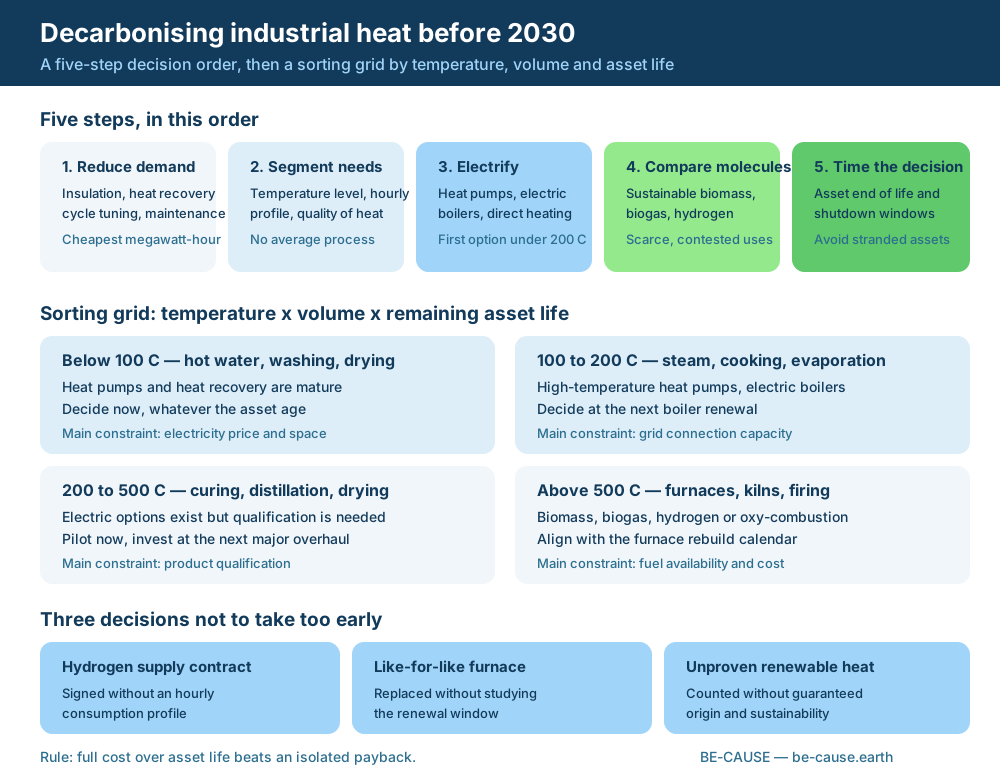
Step 1 — Eliminate the demand before choosing the energy
Every megawatt-hour removed is a megawatt-hour you do not have to electrify, buy as biomethane, or size a hydrogen contract around. Insulation of pipework and vessels, heat recovery on flue gases and effluents, cycle optimisation, condensate return, leak repair and disciplined maintenance routinely take 10 to 25% off a site's thermal demand with payback measured in months, not decades.
This step also changes the size of everything downstream. A heat pump specified before recovery is installed is a heat pump bought one size too large, at a capital cost you will carry for twenty years. Sequencing matters as much as technology choice.
Step 2 — Segment the need by temperature, hours and heat quality
There is no such thing as an average process. A site has a portfolio of thermal needs: hot water at 60 °C, steam at 180 °C, curing at 350 °C, firing above 900 °C — each with its own hourly profile, its own tolerance to interruption, and its own quality requirement in terms of temperature stability, cleanliness and contact with the product.
Segmentation is the analytical step that prevents the two classic mistakes: applying a single technology to the whole site, and disqualifying electrification because the hottest 10% of demand cannot be electrified today. Most industrial sites can decarbonise a substantial share of their heat now, and should isolate the hard fraction rather than let it block everything.
Step 3 — Test direct electrification first
Below roughly 100 °C, industrial heat pumps and heat recovery are mature and usually the lowest full-cost route, whatever the age of the existing boiler. Between 100 and 200 °C, high-temperature heat pumps and electric boilers are commercially available; the constraint is rarely the machine, it is the grid connection capacity and the electricity-to-gas price spread. Between 200 and 500 °C, electric options exist — resistive, infrared, induction, plasma depending on the process — but product qualification, not thermodynamics, is what sets the timetable.
Two cautions. Cheap renewable electricity does not compensate for an inefficient process: a badly insulated dryer stays a badly insulated dryer on green power. And a heat pump only delivers its coefficient of performance if there is a genuine low-temperature heat source on site; without it, the business case collapses.
Step 4 — Compare the molecules honestly
Above 500 °C, and for processes where a flame or a specific atmosphere is part of the product specification, molecules remain necessary. Sustainable biomass, biogas and hydrogen are all real options — and all constrained. Biomass is limited by sustainable supply and local air-quality rules. Biogas volumes are finite and already contested between heat, mobility and grid injection. Hydrogen is expensive per useful gigajoule, requires burner and safety redesign, and its low-carbon volumes are committed to uses with no alternative — ammonia, refining, some steel.
Hydrogen is not a universal answer, and treating it as one is how a credible roadmap becomes a slide. The right test is not "is it decarbonised?" but "is this the use where a scarce molecule creates the most abatement per euro and per tonne available?"
“Electrons for what can be electrified. Scarce molecules for what cannot. Anything else is a bidding war you will lose in 2032.”
Step 5 — Time the decision on the asset calendar
A furnace rebuild, a boiler replacement or a major shutdown is a window that opens once every ten to twenty years. Investing outside that window costs a premium; investing like-for-like inside it locks in fossil heat for the whole life of the new asset. The single highest-value action a management team can take this year is to map every thermal asset against its remaining life and its next shutdown, then position the decarbonisation decision on that calendar rather than on the reporting calendar.
| Temperature band | Best-placed route | When to decide | Binding constraint |
|---|---|---|---|
| Below 100 °C | Heat recovery and heat pumps | Now, whatever the asset age | Electricity price, footprint, water |
| 100–200 °C | High-temperature heat pumps, electric boilers | At the next boiler renewal | Grid connection capacity |
| 200–500 °C | Electric heating, hybrid systems | Pilot now, invest at the next overhaul | Product qualification |
| Above 500 °C | Sustainable biomass, biogas, hydrogen, oxy-combustion | At the furnace rebuild | Fuel availability and full cost |
The arbitration criteria that actually decide
- Direct and indirect emissions, including upstream fuel and grid intensity over the asset's life, not today's factor.
- Electricity price and its spread against gas, plus network charges and any capacity payment.
- Flexibility: can the process absorb interruption, load shifting or hourly price signals?
- Space, water and utilities on site — often the silent killer of an otherwise good project.
- Safety and permitting, particularly for hydrogen, biomass storage and high-voltage connections.
- Product qualification: any change to heat transfer, atmosphere or ramp rate is a quality question before it is an energy question.
- Public support schemes and their conditionality, which can move a business case by years.
- Stranded-asset risk: what happens to this investment if carbon pricing, fuel availability or customer requirements move faster than planned.
Note what is not on that list: an isolated payback figure. Full cost over the asset's life — capital, energy, maintenance, carbon, downtime and residual value — is the only comparison that survives a volatile decade.
Three decisions not to take too early
- Signing a hydrogen supply contract without an hourly consumption profile. Without load data you cannot size the contract, and you will pay for flexibility you do not need or lack the volume you do.
- Replacing a furnace like-for-like without studying the renewal window. A like-for-like rebuild is a twenty-year commitment made by default rather than by decision.
- Counting renewable heat without guaranteeing its origin. Biomass and biomethane claims need traceability, sustainability criteria and volume matching, or they will be reversed by an auditor — or by a customer's CSRD verification.
Where the market tools fit — and where they stop
Most industrial groups already run part of this stack. EcoVadis and Sedex rate management systems and policies. CDP collects the disclosure and the supply-chain questionnaire. Carbon accounting platforms such as Watershed, Persefoni, Sweep, Normative or Sphera consolidate the inventory and apply emission factors. Verification bodies such as SGS, TÜV SÜD or Bureau Veritas certify what can be evidenced. Engineering firms design the installation once the decision has been made. Each of these is good at what it was built for. None of them tells a buyer whether the supplier's boiler house can realistically move before 2030.
That is the gap our two offers fill. Net Zero Pulse screens a supplier base and returns, per site, the thermal profile, the evidence level behind the energy data and the supplier's capability to execute — so a category manager can see which factories are heat-blocked and which are one shutdown away from a decision. The Strategic Supplier Development Program then works inside the plant in the local language: load and temperature mapping, costed project options, buyer–supplier incentive design, and verification of what was actually installed and measured.
| Layer | Typical providers | What it answers | What it does not do |
|---|---|---|---|
| Supplier ratings | EcoVadis, Sedex | Does the supplier have policies and systems? | Nothing about process temperature or asset age |
| Disclosure and targets | CDP, SBTi | Is the commitment declared and aligned? | No plant-level feasibility or cost |
| Carbon accounting | Watershed, Persefoni, Sweep, Normative, Sphera | What is the consolidated footprint? | Does not build the abatement project |
| Verification | SGS, TÜV SÜD, Bureau Veritas | Is the reported figure defensible? | Verifies after the fact, does not decide |
| Screening (Net Zero Pulse) | BE-CAUSE | Which sites can evidence what — and how to steer the whole supplier ecosystem, not one factory at a time | Not a full engineering study |
| Factory execution (SSDP) | BE-CAUSE | Are the ESG commitments made by sales actually implemented by management and deployed on the shop floor — beyond paperwork and AI-filled questionnaires | Not a rating or a reporting platform |
The economics matter as much as the coverage. One supplier questionnaire cycle — chasing responses, cleaning factors, re-explaining the boundary, re-checking the same plants next year — already costs a buying team more internal hours than it ever produces tonnes. Net Zero Pulse and the Strategic Supplier Development Program are priced below the administrative time and energy the company already spends on those same suppliers, and they accelerate decarbonisation across many industries at once: the screening logic, the factory diagnosis and the evidence format hold whether the plant makes textiles, food, chemicals, electronics, packaging or auto parts. That is the moat — cheaper than the status quo, faster than a questionnaire cycle, and transferable from one sector to the next.
A twenty-four month roadmap
- Months 1–3: thermal diagnosis. Inventory of heat assets, temperatures, hourly profiles, fuels, efficiencies and remaining asset life.
- Months 4–9: metering and load data. Instrument what is not measured; nine months of real data beats a year of assumptions.
- Months 6–12: pilot. One heat pump, one electric boiler or one recovery loop on a representative line, with product qualification run in parallel.
- Months 12–18: investment decision. Full-cost comparison per temperature band, ranked against the shutdown calendar.
- Months 18–24: energy contracting. Power contracts, grid connection requests, biomass or biomethane supply with traceability written into the contract.
Two years sounds slow until you realise that the alternative — waiting for the perfect technology — usually means missing the one shutdown window available before 2030.
The question to put to your committee
Not "what is our hydrogen strategy?", but: for each thermal asset on our sites and at our strategic suppliers, do we know its remaining life, its next shutdown, its temperature band and its full-cost decarbonisation route? If the answer is no for the assets that carry most of the heat, that diagnosis is the investment to fund this quarter.
Frequently asked questions
References
- IEA — Industrial heat and net zero roadmaps
- IEA — The Future of Heat Pumps
- IEA — Global Hydrogen Review
- IRENA — Decarbonising industrial process heat
- IEA Bioenergy — Sustainable biomass supply for industry
- Mission Possible Partnership — Sector transition strategies
- European Commission — Industrial Decarbonisation Accelerator Act and Clean Industrial Deal
- GHG Protocol — Scope 1 and Scope 2 guidance
- SBTi — Corporate Net-Zero Standard
- EU — Carbon Border Adjustment Mechanism