

By Emmanuel Delplanque, Co-Founder & CEO, Be-Cause
The transition to a low-carbon economy is no longer a distant regulatory horizon; it is an immediate operational imperative. For the automotive sector, the true scale of this challenge is hidden not in the factories, but on the roads. A deep dive into the Mitsubishi Motors Sustainability 2025 report reveals a stark reality: 99% of their emissions fall under Scope 3, with the vast majority stemming from the use of sold products. This is not merely an accounting exercise—it is a mandate for fundamental business model transformation.
Executive Summary
The automotive industry stands at a critical juncture. As regulatory frameworks like the Corporate Sustainability Reporting Directive (CSRD) and the Corporate Sustainability Due Diligence Directive (CSDDD) tighten their grip on value chain transparency, automakers are being forced to confront the full lifecycle impact of their products. The days of focusing solely on factory energy efficiency are over; the spotlight is now firmly fixed on the vehicles themselves.
A close analysis of the recently published Mitsubishi Motors ESG report 2025 provides a compelling case study of this paradigm shift. While the company has made commendable strides in reducing its direct operational emissions (Scope 1 and 2), these represent a mere 1.1% of its total carbon footprint. A staggering 98.9% of its emissions are Scope 3, driven overwhelmingly by Category 3.11 use of sold products.
This data underscores a profound strategic truth: incremental efficiency gains in manufacturing are insufficient. To achieve meaningful automotive decarbonation strategy, automakers must fundamentally reallocate capital away from internal combustion engine (ICE) vehicles and toward electrified mobility. Yet, Mitsubishi Motors currently lacks near-term or long-term targets validated by the Science Based Targets initiative (SBTi), highlighting a critical gap between ambition and scientifically aligned execution.
As we navigate this complex landscape, one principle remains clear: what cannot be measured cannot be transformed. Having a precise, data-driven vision of Scope 3 emissions automotive is the essential first step on the road to a sustainable business model transformation ESG.
The Scope 3 Reality: A Look at the Numbers
To understand the magnitude of the decarbonization challenge, we must look beyond the factory gates. The Greenhouse Gas (GHG) Protocol defines Scope 3 emissions as all indirect emissions (not included in Scope 2) that occur in the value chain of the reporting company, including both upstream and downstream emissions. For automakers, the dominant category is almost universally Category 3.11 use of sold products.
The Mitsubishi Motors ESG report 2025 brings this into sharp focus. In FY2024, the company reported total GHG emissions of 30,041 thousand t-CO2 eq. Of this total, Scope 1 and 2 emissions accounted for just 328 thousand t-CO2 eq (1.1%). The remaining 29,713 thousand t-CO2 eq—an overwhelming 98.9%—fell under Scope 3.
| Emission Scope | FY2024 Volume (x10³ t-CO2 eq) | Share of Total |
|---|---|---|
| Scope 1 | 85 | 0.3% |
| Scope 2 | 243 | 0.8% |
| Scope 3 | 29,713 | 98.9% |
| Total | 30,041 | 100.0% |
Source: Mitsubishi Motors Sustainability Report 2025, p. 28.
This 98.9% figure is notably higher than the industry average. According to the Carbon Market Watch Corporate Climate Responsibility Monitor (CCRM) 2025, Scope 3 Category 11 typically accounts for 80% to 90% of a conventional vehicle manufacturer's emission footprint. Mitsubishi's outsized Scope 3 share reflects a portfolio still heavily weighted toward traditional ICE vehicles and a relatively smaller manufacturing footprint compared to industry giants.
The company's own Life Cycle Assessment (LCA) data further reinforces this point. For the 2025 model year OUTLANDER PHEV (Plug-in Hybrid Electric Vehicle), the use phase—comprising electricity production, fuel production, and driving—accounts for 54% of the vehicle's total lifecycle CO2 emissions, while production accounts for 40%. Even for a partially electrified vehicle, the downstream impact remains the primary driver of emissions.
The Strategic Imperative: Reallocating the Core Business
The implications of this data are profound. If over 50% of an automaker's total lifecycle emissions—and nearly 99% of its corporate footprint—are generated by the cars people drive, then the business model itself must shift. This is the essence of business model transformation ESG.
Decarbonization cannot be achieved through operational tweaks, such as installing solar panels on factory roofs or optimizing logistics routes, however necessary those actions may be. The core product must change. This requires a massive reallocation of assets, R&D budgets, and strategic focus away from ICE technologies and toward zero-emission vehicles (ZEVs).
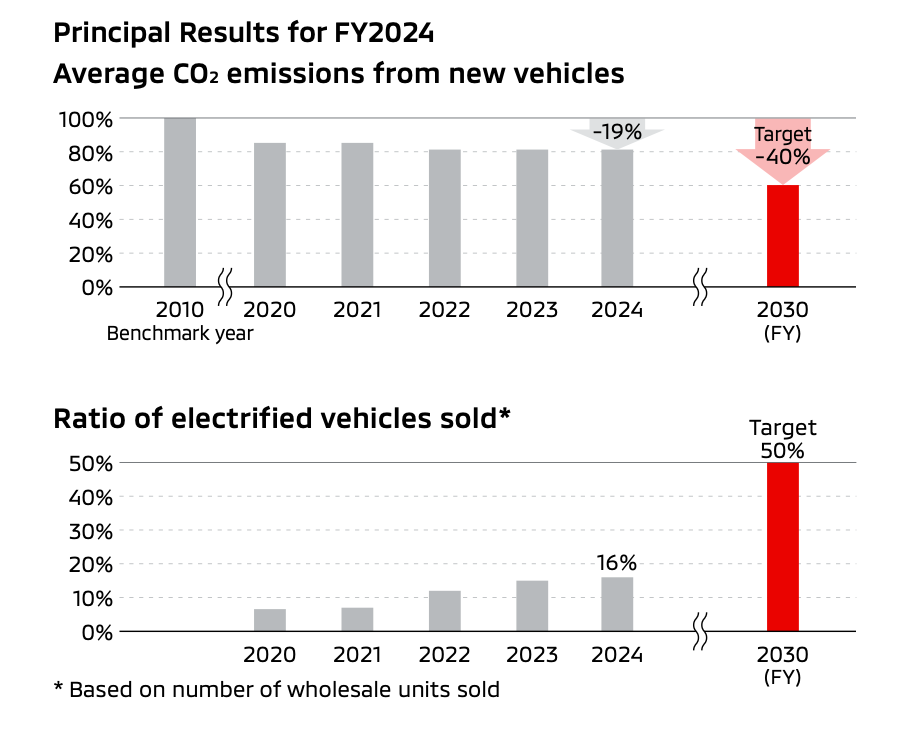
Mitsubishi Motors has set a target to raise its electrified vehicle sales ratio to 50% by FY2030 and 100% by FY2035. However, in FY2024, this ratio stood at just 16%. Furthermore, the company's definition of "electrified vehicles" includes hybrid electric vehicles (HEVs) and PHEVs, which still rely on fossil fuels and generate significant Category 3.11 use of sold products emissions.
This reliance on transitional technologies highlights a broader industry challenge. The CCRM 2025 report notes that none of the major automakers assessed—including Toyota, Volkswagen, GM, and Ford—currently have 1.5°C-aligned transition targets for a full phase-out of internal combustion engines globally. Stellantis remains the only major player with a regional 1.5°C-aligned target for the European Union by 2030.
The SBTi Gap: Ambition vs. Validation
A critical finding from the Mitsubishi Motors ESG report 2025 is the absence of near-term or long-term targets validated by the Science Based Targets initiative (SBTi). While the company states that its Environmental Targets 2030 are equivalent to the "1.5°C level of the SBT," they have not undergone the rigorous, independent validation process required by the initiative.
This is not an isolated issue. The automotive sector has historically struggled with SBTi alignment due to the complexity of Scope 3 emissions automotive accounting and the massive scale of the required transition. As of early 2026, the SBTi is finalizing its updated Automotive Sector Net-Zero Standard, which will set stricter requirements for Category 11 emissions and the phase-out of ICE vehicles.
Without SBTi validation, corporate climate pledges risk being perceived as greenwashing. Investors, regulators, and consumers increasingly demand standardized, science-based metrics to evaluate transition plans. For Mitsubishi Motors and its peers, securing this validation will be a crucial step in demonstrating the credibility of their automotive decarbonation strategy.
The Regulatory Squeeze: CSRD, CSDDD, and the EU Market
The pressure to measure and manage Scope 3 emissions automotive is no longer driven solely by voluntary initiatives; it is becoming hard law. The European Union is leading this charge through a suite of interlocking regulations that will reshape the global automotive landscape.
The Corporate Sustainability Reporting Directive (CSRD), operationalized through the European Sustainability Reporting Standards (ESRS), explicitly requires companies to disclose their Scope 1, 2, and 3 emissions. Under ESRS E1 (Climate Change), Scope 3 is treated as a core metric, forcing automakers to provide granular data on Category 3.11 use of sold products emissions and the methodologies used to calculate them.
Furthermore, the Corporate Sustainability Due Diligence Directive (CSDDD) mandates that large companies adopt and implement a transition plan for climate change. This plan must include time-bound actions and KPIs to decarbonize not just direct operations, but the entire value chain.
Even for non-EU automakers like Mitsubishi Motors, these regulations have profound implications. Any company with significant operations or sales in the EU market will be caught in this regulatory net. The recent revision of the EU's 2035 car emission standards—which now targets a 90% reduction rather than a full 100% ban on ICE vehicles—provides some flexibility for hybrids, but the overarching trajectory remains clear: the era of unchecked downstream emissions is ending.
Conclusion: Measurement as the Strategic Compass
The Mitsubishi Motors ESG report 2025 is a microcosm of the automotive industry's broader challenge. It vividly illustrates that the battle for decarbonization will be won or lost in Scope 3.
For CEOs and sustainability leaders, the takeaway is unequivocal: you cannot transform a business model without a precise understanding of its impact. Measuring Scope 3 emissions automotive is not a compliance burden; it is the strategic compass that dictates where capital must be deployed, which products must be phased out, and how the supply chain must be reconfigured.
At Be-Cause, we believe that carbon intelligence is the foundation of sustainable transformation. We partner with organizations to illuminate their value chains, providing the granular data and strategic insights needed to navigate the complex transition to a low-carbon economy.
“Because ultimately, what can't be measured can't be transformed. And in the race to net-zero, having a clear vision of the road ahead is the only way to reach the destination.”
— BE-CAUSE.EARTH | Decarbonation Architects
Ready to transform your supply chain and align your business model with a net-zero future? Discover our carbon intelligence and ESG consulting services at be-cause.earth.
Questions fréquentes
Références
- Greenhouse Gas Protocol. Corporate Value Chain (Scope 3) Accounting and Reporting Standard.
- Mitsubishi Motors Corporation. Sustainability Report 2025.
- Carbon Market Watch & NewClimate Institute. Corporate Climate Responsibility Monitor 2025: Automotive Manufacturers Sector Deep Dive. July 2025.
- Science Based Targets initiative (SBTi). Automotive Sector Net-Zero Standard, V0.1 Second Public Consultation Draft. February 2026.
- European Financial Reporting Advisory Group (EFRAG). ESRS E1 Climate Change.
- European Commission. Corporate sustainability due diligence.
- European Union. Regulation (EU) 2023/851 on CO2 emission performance standards for new passenger cars and new light commercial vehicles, revised December 2025.