
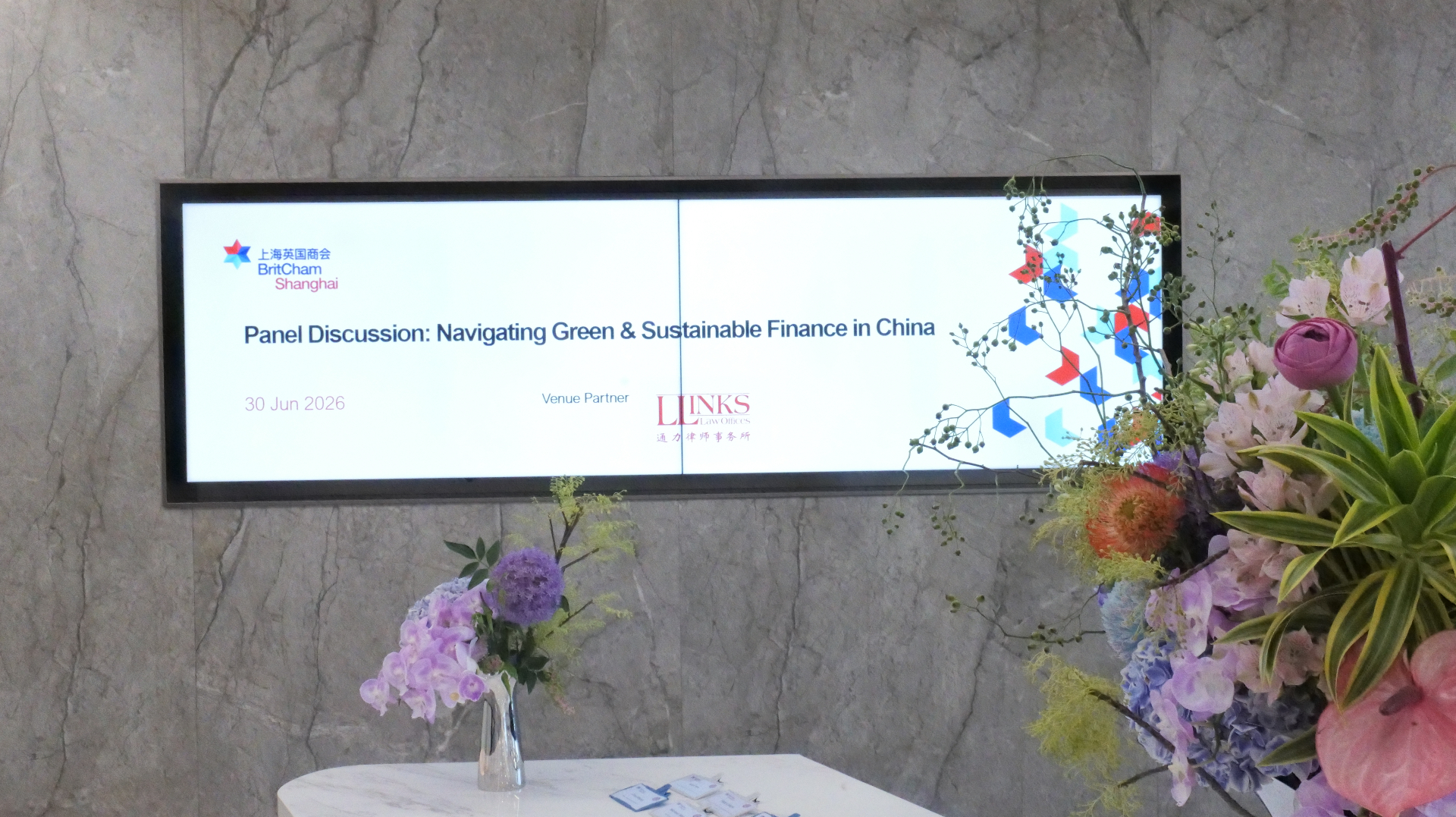
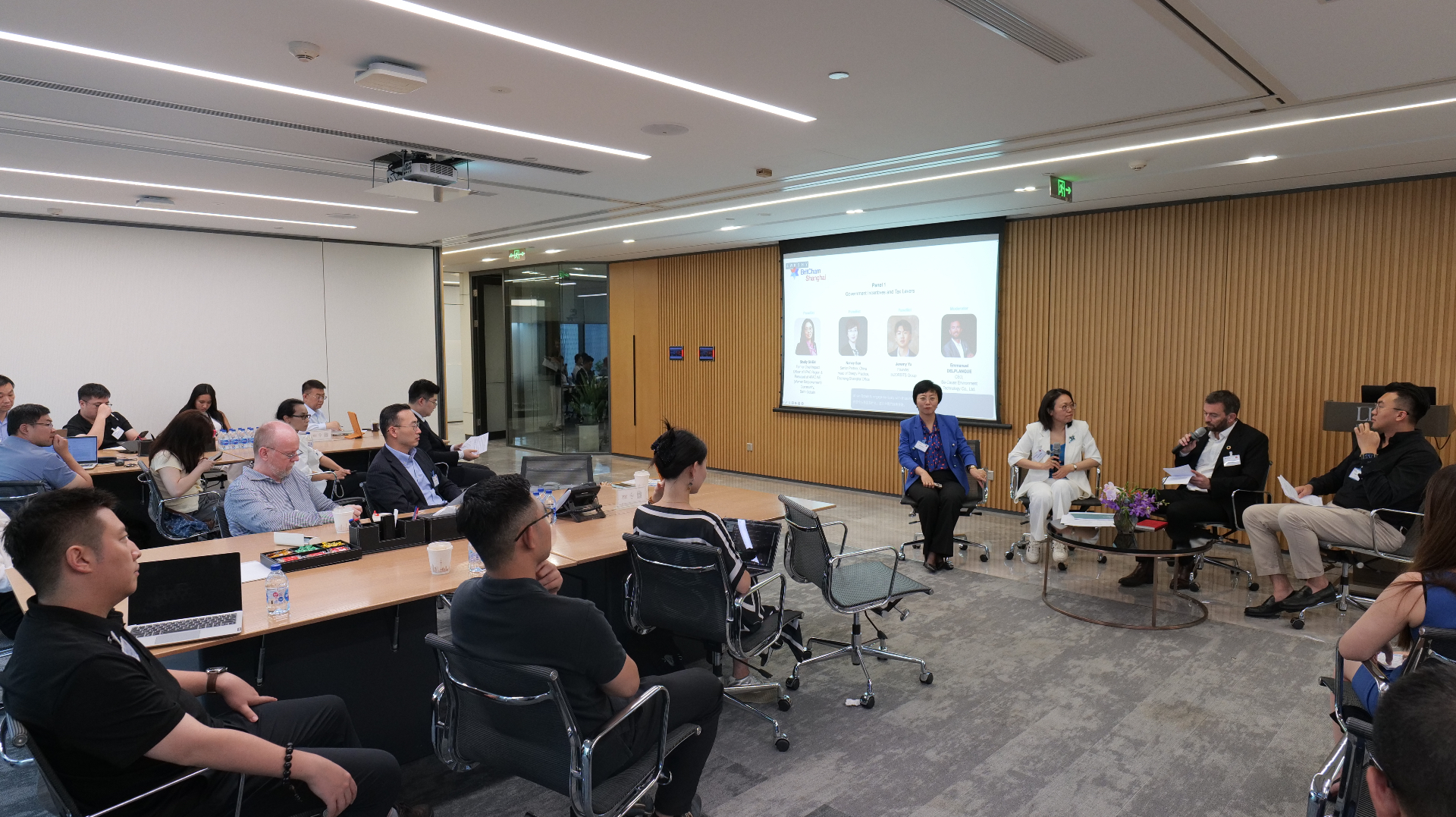
By Emmanuel Delplanque, Co-Founder & CEO of BE-CAUSE — ESG compliance SaaS accelerating industry decarbonisation across Asia and Europe. This article distils the key insights from Unlock Your Green Factory's Financial Potential, the BritCham Shanghai green finance panel held on 30 June 2026, which I had the honour of moderating with Nancy Sun (Senior Partner, Dacheng Shanghai), Jeremy Yu (Founder, IN2ORBITS) and Shelley Shen (former CIO, Saint-Gobain APAC).
Executive summary: why green finance in China matters for every foreign factory in 2026
In China, carbon is no longer just an environmental metric — it has become an economic instrument through which the government allocates capital, shapes industrial policy, and decides which companies get access to cheaper financing. Since January 2026, the People's Bank of China (PBOC) Carbon Emission Reduction Support Tool has gone national, covering 17 industrial sub-sectors from the Green and Low-Carbon Transition Industry Guidance Catalogue. Six foreign banks in Shanghai are inside the eligible scope. And Shanghai has been formally tasked with becoming an International Green Finance Hub — with an outstanding green credit balance of RMB 1.4 trillion at end of 2024, growing 20%+ per year.
For a foreign-invested factory in China, the practical question is simple: are you inside this financial architecture, or outside it? Companies inside get preferential lending rates, subsidies, tax credits, and priority in government relationships. Companies outside pay the market rate — and risk being deprioritised as the incentive phase closes and financial penalties for laggards accelerate.
Carbon as a national economic instrument: China's pilot-then-scale logic
China's green finance approach follows a deliberate sequencing logic: experiment in selected cities, then scale nationally. Shenzhen was chosen for financial market reform. Hainan for free trade. Shanghai has been chosen for green finance at the international level — formally tasked with aligning Chinese standards with international frameworks and positioning the city as a bridge between Chinese and global capital flows for the low-carbon transition.
This is not marketing. By end of 2024, Shanghai's outstanding green credit balance had reached RMB 1.4 trillion, growing at more than 20% year on year. The city has become the operational test bed for every major green finance mechanism China rolls out, before those mechanisms are extended nationally.
The PBOC Carbon Emission Reduction Support Tool: from clean energy to 17 industrial sub-sectors
The PBOC Carbon Emission Reduction Support Tool is a central refinancing facility that allows Chinese and eligible foreign banks to lend to qualifying green projects at preferential rates, with the central bank backing part of the loan. Its scope has expanded dramatically:
| Date | Milestone | Practical meaning |
|---|---|---|
| 2021 | PBOC launches the Carbon Emission Reduction Support Tool, restricted to clean energy generation (wind, solar, nuclear, hydro, biomass). | Traditional industry is excluded — only new clean-power assets qualify. |
| Feb 2024 | NDRC and six other ministries publish the Green and Low-Carbon Transition Industry Guidance Catalogue. | Formal recognition that decarbonising existing industries matters as much as building new clean energy. |
| Mar 2024 | PBOC Shanghai Headquarters expands the Tool to 17 industrial sub-sectors from the Catalogue. Six foreign banks in Shanghai are explicitly included. A GHG emissions report becomes the entry ticket. | For the first time, retrofitting a production line qualifies for central bank-backed lending — through your foreign bank. |
| Jun 2025 | At the Lujiazui Forum, PBOC Governor Pan Gongsheng announces national expansion. | Signal to the market: the Shanghai pilot is the template. |
| Jan 2026 | The PBOC issues a national announcement confirming the expansion. Energy-saving retrofits, green upgrades and low-carbon transition projects in traditional industries are now eligible across China. | Green finance moves from a Shanghai advantage to a nationwide baseline. |
What the 17 industrial sub-sectors actually cover
The 17 sub-sectors are drawn from seven major categories defined by the Catalogue: energy conservation and carbon reduction, clean production, clean energy, eco-environment, green upgrading of infrastructure, green services, and low-carbon technologies. In practical terms, they cover routine industrial operations — not exotic technologies:
- Industrial energy efficiency retrofits — boilers, heat exchange systems, variable-frequency drives.
- Industrial solid waste utilisation and recovery.
- Waste gas recovery and reuse.
- Industrial park circular economy transformation.
- Clean production process upgrades across high-carbon manufacturing sectors.
- Substitution of high-carbon materials with lightweight or lower-carbon alternatives.
For most foreign manufacturers, these are activities already on the CAPEX roadmap for cost and efficiency reasons. The green finance layer means they can now be structured to unlock central bank-backed lending at preferential rates, on top of the subsidy and tax incentive stack that already exists.
Round 1 — How policy translates into concrete financial benefits
Shelley Shen opened the panel by recounting how Saint-Gobain Asia engaged with China's green mechanisms. The decision was not driven by environmental conviction alone but by a pragmatic recognition: the financial architecture the Chinese government has built is real, accessible, and significant in scale. What it demands is internal alignment across finance, operations and government affairs — and an understanding that Chinese green investment is fundamentally project-based. It rewards companies that can demonstrate concrete, measurable outcomes, not those that simply declare intentions.
Jeremy Yu (IN2ORBITS) then moved the discussion from policy to physical implementation. IN2ORBITS operates precisely in the territory covered by the 17 sub-sectors: industrial solid waste utilisation, waste gas recovery, circular economy retrofits. His central point: the same project attracts very different levels of support depending on district — Jinshan, Songjiang, Pudong and Xuhui each have their own award structures, thresholds and strategic priorities. District choice is a strategic financial decision, not an administrative one.

Nancy Sun (Dacheng Shanghai) closed the round by mapping the financial translation mechanism. A sustainability project only becomes financially valuable when it is formally recognised by the system — through national, provincial and municipal subsidies, accelerated tax depreciation on green equipment, the 10% R&D tax credit on green technology investment, and preferential lending rates unlocked by certification. For a well-structured project, the combined benefit is not marginal.
Round 2 — Certification, proof, and the sequencing problem
The most common mistake foreign companies make in Chinese green finance is a sequencing mistake: they identify the financing opportunity first and then try to build the project around it. IN2ORBITS works the other way around. Before approaching a bank or a government body, the company must have something already built — a project designed, implemented and documented with results. The proof is not a business plan; it is operational evidence: material flow data, carbon reduction figures, third-party verification.
“Build before you finance. Arriving at the financing conversation with operational evidence already in hand changes the nature of the discussion entirely.”
— Jeremy Yu, IN2ORBITS
Certification is the gateway. Green Factory certification — issued by the Ministry of Industry and Information Technology (MIIT) — is not a badge. It is the formal credential that unlocks subsidy eligibility, preferential lending access and tax advantages. Upcoming standard revisions — including stricter requirements on carbon management systems and supply chain transparency — will affect both existing certified companies and new applicants. Early engagement with the certification process is therefore a strategic priority, not a compliance chore.
Round 3 — Government relationships, global drivers, and legal risk
Chinese government counterparts do not engage seriously with companies that present themselves as passive recipients of incentives. They engage with companies that can demonstrate alignment with local industrial policy objectives — job creation, technology transfer, district-level decarbonisation targets. Framing the company's project in those terms is what unlocks the relationship.
There is a growing convergence between Chinese requirements and global ESG frameworks — but they are not yet fully aligned. Chinese authorities focus on physical outcomes: tonnes of waste recovered, kilowatt-hours saved. Global frameworks (CSRD, SBTi, CDP) increasingly require granular, audit-ready carbon data across the full supply chain. Companies that build systems capable of satisfying both simultaneously will be significantly better positioned than those that run two separate compliance exercises.
Four legal and compliance risks deserve particular attention as data flows between local projects, Chinese certification systems and global ESG reporting:
- Data disclosure obligations and their interaction with Chinese data sovereignty rules (Decrees 834 & 835, PIPL, DSL).
- Ongoing maintenance requirements for certifications, often underestimated after initial approval.
- Structuring of green financing instruments to avoid reclassification risk.
- Legal exposure associated with public sustainability claims — greenwashing enforcement is intensifying both in China and in Europe.
The convergence of Chinese and European disclosure obligations
Chinese stock exchange sustainability reporting guidelines are now mandatory for A-share listed companies from fiscal year 2025. European CSRD obligations are progressively extending Scope 3 reporting requirements to non-EU companies operating in Europe. For a foreign manufacturer in Shanghai, both systems are converging on the same question: can you account for the carbon in your supply chain?
Today, Chinese disclosure frameworks are focused on direct operations and immediate supply chain relationships. CSRD Scope 3 requirements extend further upstream and downstream. Companies that begin building their data infrastructure now — traceability systems, carbon accounting, third-party verification — will satisfy both frameworks as they tighten, rather than facing two separate compliance builds under time pressure.
Key takeaways for foreign factories in China in 2026
- Build before you finance. Successful applicants arrive with a designed, implemented and documented project — not with a financing opportunity in search of a project.
- District choice is a strategic decision. Jinshan, Songjiang, Pudong and Xuhui offer different programmes, thresholds and relationship dynamics. Where you locate or structure a project is as important as what the project does.
- The 2026 window is real. The Shanghai ESG three-year action plan for foreign-invested enterprises closes at end of 2026. Companies that formalise ESG reporting, engage with certification and build government relationships during this window will be better positioned when incentives shift toward penalties.
- GHG reporting is now the entry ticket. Without a robust greenhouse gas emissions report, the PBOC tool is inaccessible. Carbon accounting has become the precondition for cheaper capital.
- Design data architecture once, use it everywhere. A single, verifiable dataset can serve Green Factory certification, PBOC eligibility, CSRD, SBTi and customer disclosures — provided it is designed with data sovereignty rules in mind.
How BE-CAUSE helps foreign factories unlock China's green finance stack
BE-CAUSE is an ESG compliance SaaS platform accelerating industry decarbonisation across Asia and Europe. We help foreign-invested factories in China translate operational reality into the audit-ready data the PBOC, MIIT, Chinese stock exchanges and European CSRD all now require. Our platform combines Scope 1–2–3 carbon accounting, supplier traceability, Green Factory readiness diagnostics, and a data architecture aligned with Chinese data sovereignty rules (Decrees 834 & 835) and European disclosure standards. If you are a CFO, CSO, plant manager or country GM navigating Chinese green finance in 2026, we can help you move from ambition to eligibility.


Questions fréquentes
Références
- BritCham Shanghai — Unlock Your Green Factory's Financial Potential (30 June 2026)
- People's Bank of China — Carbon Emission Reduction Support Tool
- NDRC — Green and Low-Carbon Transition Industry Guidance Catalogue (2024)
- Ministry of Industry and Information Technology (MIIT) — Green Factory Program
- Shanghai Municipal Commission of Commerce — ESG action plan for foreign-invested enterprises
- European Commission — Corporate Sustainability Reporting Directive (CSRD)
- BE-CAUSE — ESG compliance SaaS for Asia and Europe